Anonymous observational research on real-world SR-17018 use.
This project collects community-reported experiences to better understand perceived outcomes, adverse events, withdrawal experiences, and opioid-response changes associated with SR-17018.
Participate in the survey
If you have used SR-17018, your experience may help document real-world patterns that are currently absent from the scientific literature. The survey is anonymous, voluntary, and intended for aggregate observational analysis.
Open Anonymous SurveyPreprint and publication status
The early manuscript is available as a preprint and is currently in the journal submission process for peer-reviewed publication.
Read the preprint: Observational Characterization of Self-Reported SR-17018 Exposure and Outcomes.
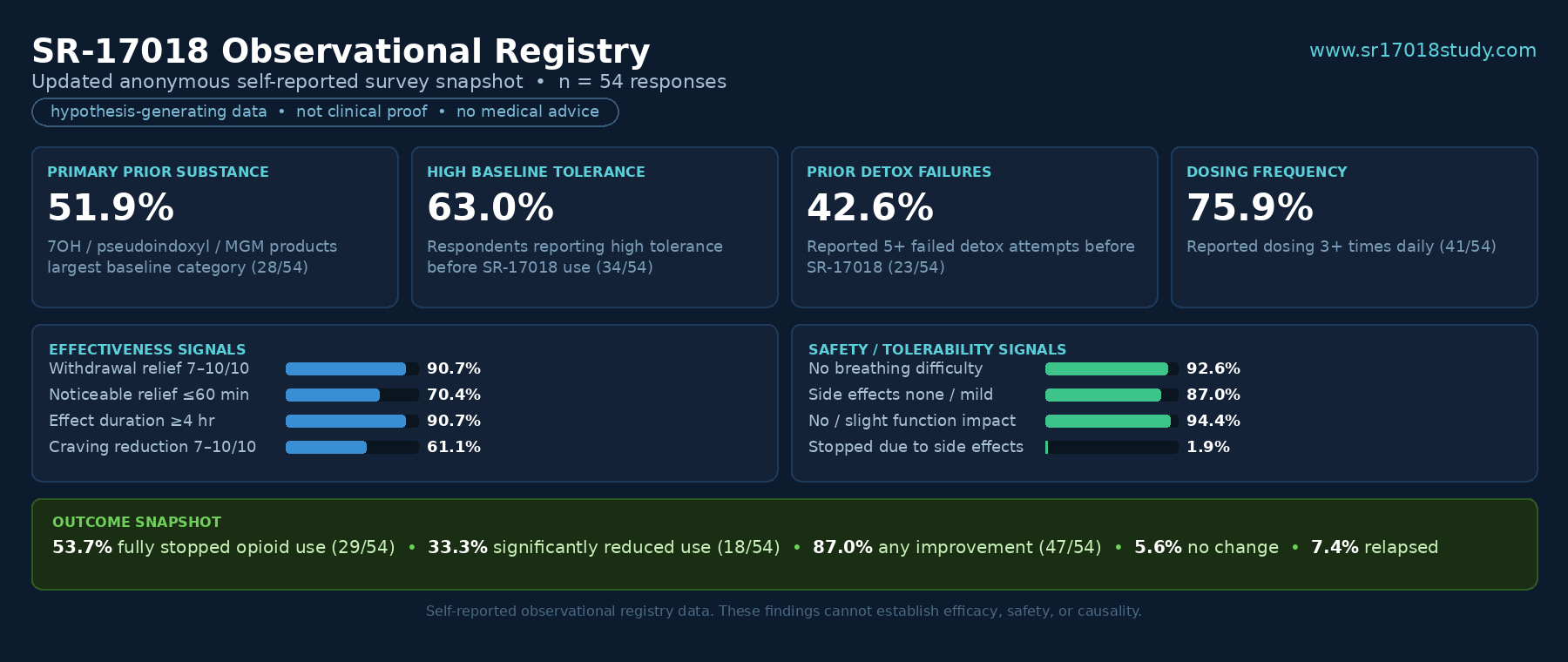
Early observational data
Initial findings are descriptive, anonymous, self-reported, and hypothesis-generating. They cannot establish efficacy, safety, or causality.
Research Library
Internal links to the full SR-17018 research library.
SR-17018 and Biased Agonism
Mu opioid receptor signaling, G-protein pathways, β-arrestin recruitment, tolerance, and withdrawal biology.
CoreSR-17018 and Opioid Withdrawal
Withdrawal biology, MOR stabilization, dependence, and the limits of preclinical evidence.
CoreSR-17018 and Opioid Tolerance
Receptor adaptation, desensitization, tolerance biology, and dependence questions.
CoreSR-17018 Availability, COAs & Testing
Certificates of analysis, purity testing, contamination risk, and research-chemical caution.
AuthorityIs SR-17018 Legal?
Federal Analogue Act risk, research-chemical disclaimers, and why unscheduled does not mean legally safe.
AuthoritySR-17018, 7-OH, MGM-15 & Attribution
Why mixed exposures make real-world outcome attribution difficult.
AuthoritySR-17018 Human Data
Observational reports, preclinical evidence, and the limits of current human evidence.
AuthoritySR-17018 Side Effects
Known opioid-class concerns, self-reported effects, unknowns, and harm-reduction caution.
AuthoritySR-17018 Half-Life and Duration
Pharmacokinetics, duration uncertainty, and why animal data do not create a human protocol.
AuthoritySR-17018 and Respiratory Depression
Respiratory safety signals, overdose risk, and the limits of preclinical interpretation.
AuthoritySR-17018 Mechanism of Action
MOR signaling, biased agonism, receptor kinetics, tolerance, and pharmacology.
New / ContextThe History of SR-17018
From Scripps Research and biased agonism to online communities and real-world reports.
New / Legal RiskSR-17018 Civil Liability Risk
Why unscheduled does not protect sellers from product-liability and wrongful-death claims.
New / SafetyDoes Naloxone Reverse SR-17018?
Overdose risk, naloxone response, repeat dosing, and the duration mismatch problem.
New / DependenceIs SR-17018 Addictive?
Dependence, withdrawal, animal data, and the non-addictive opioid myth.
ComparisonSR-17018 vs Oxycodone
Mechanism, evidence, overdose risk, and the opioid epidemic history behind oxycodone.
New / Clinical AwarenessSR-17018 Supply Chain Verification
Clinical awareness is rising. The supply chain is the real danger — and verification is the answer.
ComparisonSR-17018 vs Buprenorphine
Approved medication versus experimental compound: receptor signaling, withdrawal, evidence, and caution.
ComparisonSR-17018 vs Methadone
Methadone evidence and regulation compared with SR-17018’s experimental status.
ComparisonSR-17018 vs Fentanyl
Fentanyl-era risk, MOR signaling, withdrawal, tolerance, and evidence limits.
ComparisonSR-17018 vs Heroin
Heroin comparison, overdose risk, withdrawal context, and harm-reduction framing.
ComparisonSR-17018 vs Morphine
Morphine tolerance models, withdrawal, respiratory risk, and SR-17018 research relevance.
ComparisonSR-17018 vs Kratom
Kratom, mitragynine, 7-OH, extracts, and why risk depends on product category.