SR-17018 vs Buprenorphine
A harm-reduction comparison of receptor signaling, opioid withdrawal, tolerance, dependence, human evidence, and why SR-17018 should not be treated as a proven replacement for buprenorphine.
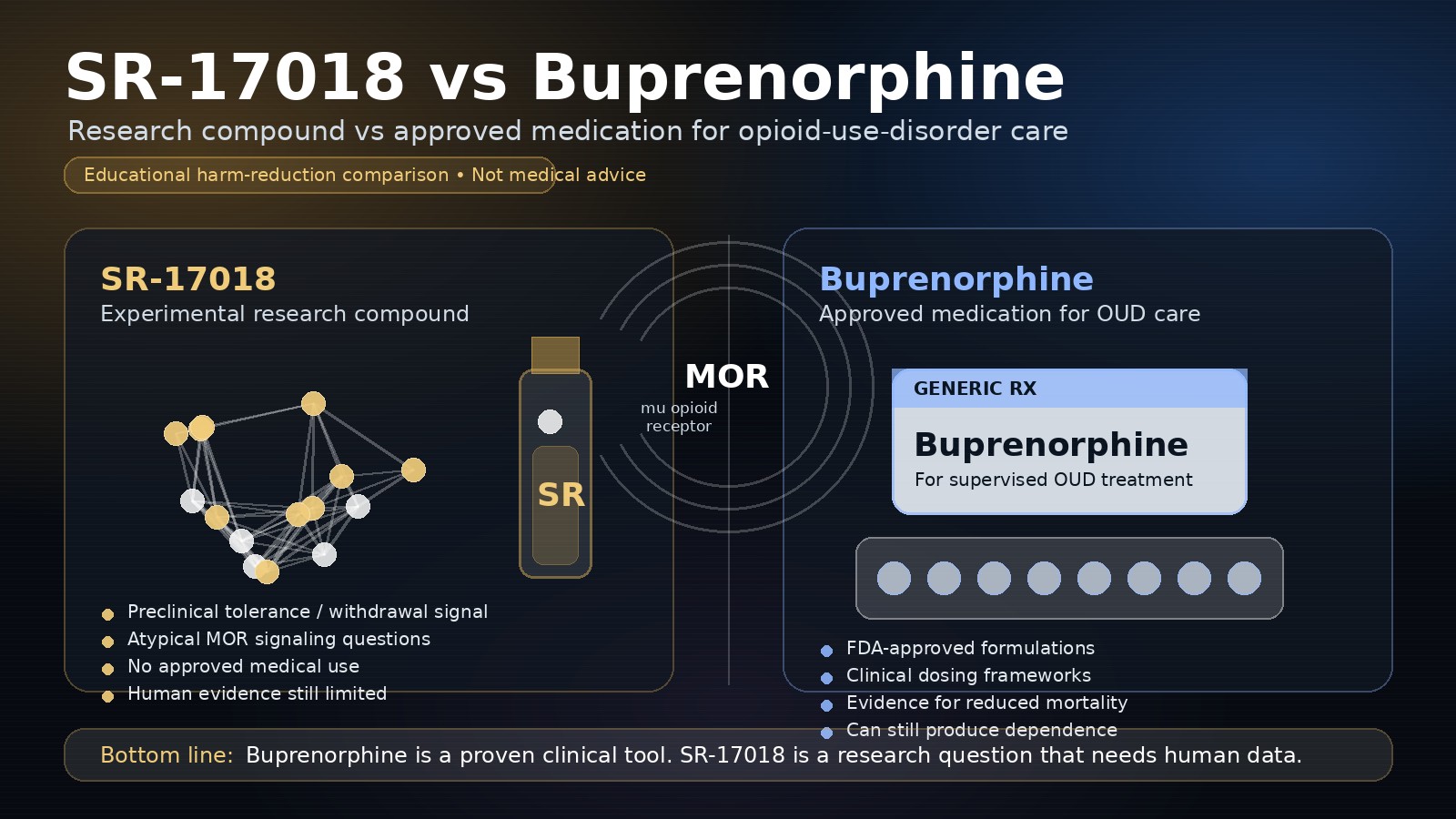
SR-17018 and buprenorphine are sometimes discussed in the same online conversations because both interact with the mu opioid receptor and both appear in discussions involving opioid withdrawal, tolerance, stabilization, and harm reduction.
That comparison is understandable.
It is also easy to get wrong.
Buprenorphine is an approved medication with decades of clinical use. SR-17018 is an experimental research compound with limited human data.
That single distinction should shape the entire conversation.
The Short Version
SR-17018
SR-17018 is a research compound studied preclinically as an atypical mu opioid receptor agonist with interest around G-protein signaling bias, tolerance, withdrawal, and receptor adaptation.
Buprenorphine
Buprenorphine is an FDA-approved medication used in opioid use disorder treatment and pain contexts depending on formulation. It has clinical dosing frameworks, medical oversight systems, and a large evidence base.
The responsible comparison is not “which one is better?” The better question is:
What does each compound teach us about opioid receptor stabilization, and what level of evidence supports each claim?
What Is Buprenorphine?
Buprenorphine is a partial mu opioid receptor agonist. In opioid use disorder treatment, it can reduce withdrawal symptoms and cravings while producing a ceiling effect on some opioid effects compared with full agonists.
Buprenorphine is also high-affinity, meaning it binds strongly to the mu opioid receptor. This can help stabilize receptor activity, but it is also why timing matters clinically when transitioning from other opioids, especially fentanyl. If buprenorphine displaces a full agonist too abruptly in a dependent person, precipitated withdrawal can occur.
Unlike SR-17018, buprenorphine has formal medical use, approved products, labeling, prescribing standards, clinical experience, and population-level evidence supporting its role in reducing opioid-related harm.
What Is SR-17018?
SR-17018 is an experimental mu opioid receptor ligand that has attracted attention because preclinical studies suggest it may behave differently from classical opioids in certain models of tolerance, withdrawal, respiratory effects, and receptor signaling.
The main scientific interest is not simply that SR-17018 activates the mu opioid receptor. The interest is that it appears to produce an atypical signaling profile compared with many traditional opioids.
Some preclinical research has reported that SR-17018 can reverse morphine tolerance and prevent morphine withdrawal signs in animal models. Other work has shown that SR-17018 produces unusual receptor phosphorylation and dephosphorylation dynamics, suggesting that its receptor behavior may not fit simple opioid categories.
SR-17018 is scientifically important because it raises questions about whether opioid receptor signaling can be modified in ways that alter tolerance and withdrawal biology.
Receptor Signaling: Partial Agonism vs Biased/Atypical Signaling
Buprenorphine is usually discussed as a partial agonist with high receptor affinity. Clinically, this matters because it can suppress withdrawal and cravings while reducing some risks associated with uncontrolled full agonist opioid use.
SR-17018 is usually discussed through the lens of biased or atypical mu opioid receptor signaling. That means the conversation focuses less on approved clinical use and more on how the receptor behaves after activation.
These are different frameworks.
- Buprenorphine: clinically established partial agonist used for stabilization.
- SR-17018: experimental compound studied for unusual MOR signaling and adaptation effects.
Both conversations involve the mu opioid receptor, but they are not interchangeable.
Withdrawal and Stabilization
Buprenorphine is used clinically because it can stabilize opioid receptor activity and suppress withdrawal in many patients with opioid use disorder.
SR-17018 is discussed in withdrawal communities because animal studies suggest it may interact with dependence and withdrawal biology in unusual ways. However, preclinical withdrawal findings are not the same as a validated human detox protocol.
This distinction matters because opioid withdrawal is not a controlled laboratory event in real life. Human withdrawal often involves fentanyl exposure, polysubstance use, malnutrition, insomnia, trauma, chronic pain, psychiatric symptoms, and product variability.
Buprenorphine has clinical infrastructure. SR-17018 has scientific questions.
Tolerance and Dependence
Buprenorphine can produce physical dependence. Patients may experience withdrawal if it is stopped abruptly, and tapering can be difficult for some people. That does not make buprenorphine ineffective. It means opioid receptor stabilization still involves opioid receptor adaptation.
SR-17018 has drawn interest because some preclinical studies suggest it may produce a different tolerance profile than classical opioids in certain experimental settings. But this has not been proven as a human treatment advantage.
A cautious interpretation is necessary:
- SR-17018 may be mechanistically interesting for tolerance research.
- Buprenorphine is clinically useful but can still produce dependence.
- Neither compound should be simplified into “safe” or “dangerous” without context.
Evidence Comparison
| Category | Buprenorphine | SR-17018 |
|---|---|---|
| Regulatory status | Approved medication in specific formulations and indications. | Research compound; not approved as a medication. |
| Human clinical evidence | Large clinical and public-health evidence base for opioid use disorder treatment. | Very limited human evidence; mostly preclinical and observational discussion. |
| Withdrawal role | Used clinically to suppress withdrawal and cravings in OUD treatment. | Discussed because of preclinical withdrawal/tolerance findings, but not validated clinically. |
| Tolerance/dependence | Can stabilize OUD but can also produce physical dependence and withdrawal when stopped. | Preclinical data suggest atypical tolerance effects, but human relevance remains uncertain. |
| Medical oversight | Prescribable, monitored, and supported by treatment systems. | No approved dosing, induction, tapering, or monitoring protocol. |
| Best current interpretation | Evidence-based medication for OUD when used under medical care. | Scientifically important compound requiring human research and cautious interpretation. |
Why People Compare SR-17018 to Buprenorphine
The comparison usually appears for practical reasons. People struggling with opioid dependence often want to know whether SR-17018 could do something similar to buprenorphine: reduce withdrawal, stabilize receptor activity, avoid severe intoxication, and allow a transition away from more dangerous opioids.
That question is understandable in the fentanyl era. Many people report difficult buprenorphine inductions, fear precipitated withdrawal, or struggle with long tapers. Those realities are part of why alternative compounds attract attention.
But unmet need is not the same thing as proof.
The existence of problems with current medications does not automatically validate an experimental replacement.
Why SR-17018 Should Not Be Marketed as “Better Suboxone”
A dangerous misunderstanding would be to frame SR-17018 as a hidden or superior version of buprenorphine.
That is not scientifically justified.
Buprenorphine has limitations, but it also has known clinical value, regulated products, medical monitoring, and evidence showing reductions in overdose mortality when used as part of treatment. SR-17018 does not currently have that level of evidence.
SR-17018 may deserve serious research. It may even help scientists think differently about opioid transition medications. But that is not the same as claiming it is already a proven alternative.
The Human Data Problem
The central issue is human data.
Animal models can show receptor signaling patterns, tolerance effects, withdrawal-related behaviors, and pharmacological differences. These findings matter. They are the reason SR-17018 deserves attention.
But human opioid dependence is more complex than a laboratory model.
Before SR-17018 could be responsibly compared to buprenorphine as a treatment, researchers would need controlled human data addressing:
- pharmacokinetics
- dose-response relationships
- safety and adverse effects
- respiratory effects
- drug interactions
- withdrawal suppression
- reward and abuse liability
- tolerance and dependence
- taper outcomes
Without that evidence, strong clinical claims are premature.
FAQ
Is SR-17018 the same as buprenorphine?
No. Buprenorphine is an approved medication with established clinical use. SR-17018 is an experimental research compound without approved medical use.
Can SR-17018 replace buprenorphine?
There is not enough human evidence to make that claim. SR-17018 should not be treated as a proven replacement for buprenorphine.
Why are people comparing them?
They are compared because both interact with the mu opioid receptor and both appear in discussions about withdrawal, stabilization, tolerance, and opioid transition strategies.
The Real Takeaway
Buprenorphine and SR-17018 belong in the same broad opioid receptor conversation, but they do not occupy the same evidence category.
Buprenorphine is an established medication used in real clinical treatment. SR-17018 is an experimental compound that raises important questions about receptor signaling, tolerance, and withdrawal biology.
The most responsible position is not hype or dismissal.
Buprenorphine is a proven clinical tool. SR-17018 is a scientifically important research question.
That distinction is exactly why observational data, cautious reporting, and serious human research matter.
Sources and Further Reading
- Grim TW et al. A G protein signaling-biased agonist at the μ-opioid receptor reverses morphine tolerance while preventing morphine withdrawal. Neuropsychopharmacology. PMC full text.
- Fritzwanker S et al. SR-17018 stimulates atypical μ-opioid receptor phosphorylation and dephosphorylation. British Journal of Pharmacology. PMC full text.
- FDA prescribing information for SUBOXONE sublingual film. FDA label.
- FDA statement on labeling updates for transmucosal buprenorphine products indicated for opioid use disorder. FDA.
- National Institutes of Health. Methadone and buprenorphine reduce risk of death after opioid overdose. NIH.
- National Institute on Drug Abuse. Medications for Opioid Use Disorder. NIDA.