SR-17018 Availability, COAs & Research Chemical Considerations
Why laboratory verification, analytical testing, contamination awareness, and realistic sourcing discussions matter in the modern research chemical environment.
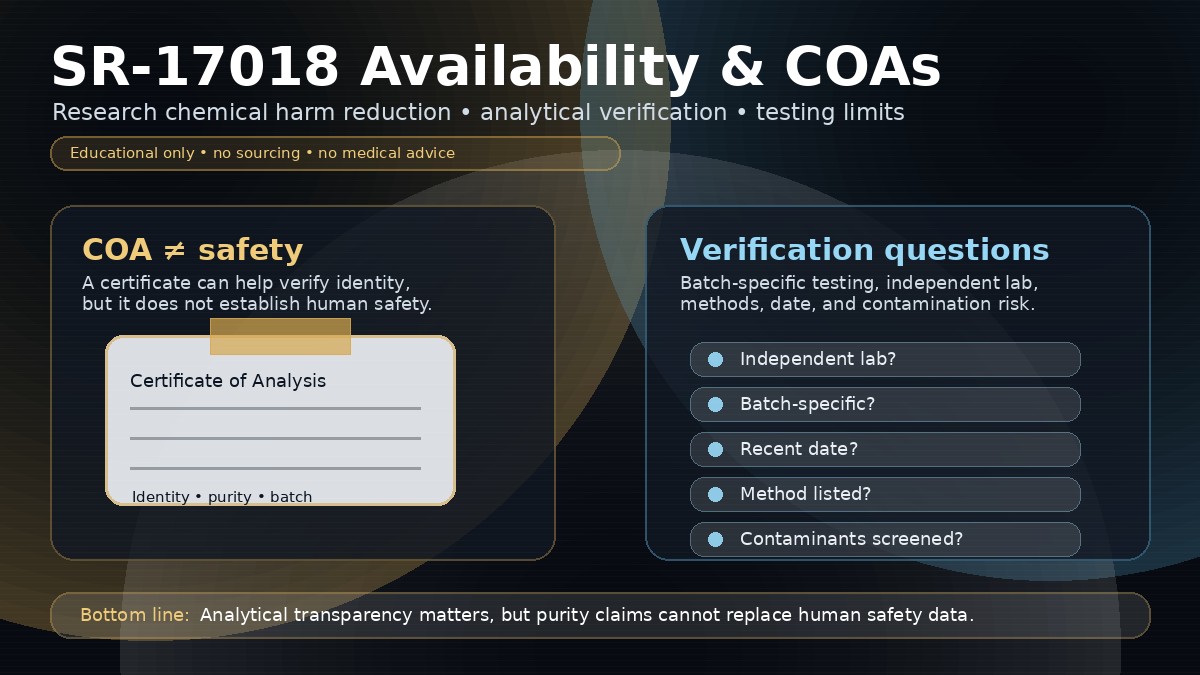
As SR-17018 has gained visibility online, more people have begun asking questions about availability, sourcing, purity, and laboratory testing.
This creates an uncomfortable reality:
People are already accessing research chemicals whether public health systems are prepared for it or not.
In environments like this, harm reduction and analytical transparency become critically important.
One of the biggest problems in underground or gray-market research chemical spaces is that buyers often assume a label guarantees identity or purity.
History repeatedly shows otherwise.
What Is a COA?
COA stands for Certificate of Analysis.
In theory, a COA is intended to verify:
- compound identity
- purity percentage
- batch testing
- analytical methodology
- presence or absence of contaminants
Legitimate laboratory analysis may involve methods such as:
- HPLC: High Performance Liquid Chromatography
- LC-MS: Liquid Chromatography-Mass Spectrometry
- GC-MS: Gas Chromatography-Mass Spectrometry
- NMR spectroscopy
In responsible scientific settings, these methods help confirm that a material is actually what it claims to be.
A professionally generated COA is generally better than no analytical verification at all, but a COA is not the same thing as guaranteed safety.
Why COAs Matter in the Fentanyl Era
Modern drug markets are increasingly contaminated, inconsistent, and unpredictable.
The fentanyl era has shown how easily substances can become:
- misidentified
- cross-contaminated
- adulterated
- improperly synthesized
- incorrectly labeled
This risk extends beyond illicit street drugs. Any poorly regulated research chemical market can involve batch inconsistency, residual solvents, synthetic byproducts, incorrect potency claims, and contamination from shared manufacturing equipment.
The Problem With “Trust Me Bro” Chemistry
One of the biggest mistakes in research chemical culture is assuming that online reputation alone guarantees legitimacy.
Attractive websites, influencer marketing, Telegram communities, or polished branding do not replace laboratory verification.
A vendor may:
- resell material from unknown upstream labs
- lack pharmaceutical manufacturing standards
- fail to perform batch-specific testing
- reuse old COAs across unrelated batches
- lack contamination screening
In some cases, COAs themselves may be outdated, incomplete, unverifiable, or manipulated.
Harm reduction begins with skepticism, not blind trust.
What a Responsible COA Should Include
While standards vary widely, a more credible analytical document generally includes:
- batch or lot number
- testing date
- testing laboratory information
- analytical methods used
- purity percentages
- chromatogram or spectral data
- analyst signatures or identifiers
Ideally, testing should also be batch-specific, recent, and performed by an independent laboratory.
Many consumers never ask these questions.
They should.
Why Purity Alone Is Not Enough
A common misunderstanding is that “99% purity” automatically means a material is safe.
It does not.
Purity percentages may not identify:
- toxic synthesis byproducts
- micro-contamination
- cross-batch contamination
- residual solvents
- bacterial contamination
- degradation products
Nor does purity address the larger issue:
Human pharmacology may still be poorly understood even if the chemistry is correct.
This is especially important for experimental compounds without formal human safety studies.
The Reference Standard Problem: Purity Is Not Identity
There is a deeper issue that most COA discussions never reach, and it is the single most important thing to understand when reading one.
A purity percentage and a confirmed identity are two different claims.
A laboratory can report that a sample is "99% pure" and be telling the truth in a narrow sense — meaning that of everything its instrument detected, roughly 99% showed up as a single dominant compound. That tells you the material is clean. It does not, by itself, tell you the dominant compound is actually the substance on the label.
Confirming identity — proving that the peak really is SR-17018 and not a structurally similar molecule — usually requires a certified reference standard: a small, independently characterized quantity of the known compound that the lab compares the sample against. Without that standard, a lab can describe the shape of a sample (one clean peak versus a mixture) but cannot definitively match it to a specific named molecule.
This matters because certified reference standards for newer or non-mainstream compounds are often expensive, not stocked, or simply unavailable. A laboratory that specializes in other materials — for example, a cannabis or hemp testing lab — may run a sample as a one-off without a matching standard at all. The resulting document can look authoritative while resting on an assumption: that the material is what the client said it was.
The only ways to confirm identity without a pre-existing standard are full structural techniques such as NMR combined with high-resolution mass spectrometry, or quantitative NMR (qNMR) for absolute purity. These are more involved and more expensive than the analysis behind a typical one-line purity COA, and they are rarely what produces the documents circulating in online communities.
The practical takeaway:
- A purity number tells you how clean a sample is, not what it is.
- Identity confirmation generally requires a reference standard or full spectroscopic characterization.
- A COA that reports a purity percentage but names no method, shows no chromatogram, and references no standard has not actually confirmed identity — it has reported cleanliness and assumed identity.
This is not a reason to dismiss all COAs. It is a reason to read them for what they actually establish rather than what their formatting implies.
Two specific things are worth checking, because their absence is common and revealing:
- Whether the analytical method is named. A COA that reports a number but never states whether it came from HPLC, LC-MS, GC-MS, or NMR has not given you enough to judge it.
- Whether the result falls within the lab's accreditation. Accredited laboratories (for example, those operating under ISO 17025) are accredited for specific analytes using validated methods. A result marked "beyond scope of accreditation" — language that appears on real documents — means the lab ran the test outside its validated, accredited method set. That does not make the result wrong, but it means the accreditation that makes the lab trustworthy for its core work does not extend to that particular number.
Can a COA confirm the material is actually SR-17018?
Only under specific conditions. Confirming identity — not just purity — generally requires the testing laboratory to compare the sample against a certified reference standard, or to perform full structural analysis such as NMR with high-resolution mass spectrometry. A COA that reports a purity percentage without a named method, chromatogram, or reference standard demonstrates that a sample is relatively clean, but does not independently confirm that the compound is SR-17018.
Why SR-17018 Creates Unique Questions
SR-17018 occupies a strange position.
Unlike many historical research chemicals, SR-17018 originated from legitimate pharmaceutical research exploring opioid receptor signaling and biased agonism.
At the same time, the compound now exists within online research chemical environments that lack pharmaceutical oversight.
This creates a dangerous gap between:
- scientific curiosity
- commercialization
- harm reduction
- regulatory uncertainty
The existence of a promising mechanism does not eliminate:
- purity concerns
- batch inconsistency
- contamination risk
- mislabeling risk
- human toxicity uncertainty
The Real Harm Reduction Position
Responsible harm reduction is not blind promotion, panic, or denial.
It is realistic acknowledgement that:
- people already access research chemicals
- many compounds are poorly characterized
- modern drug markets are contaminated
- analytical transparency matters
- better public education is needed
The most dangerous environment is one where:
- people trust vendors blindly
- no one discusses contamination
- nobody asks for analytical verification
- mechanistic excitement replaces critical thinking
A scientifically interesting compound still deserves scientific skepticism.
FAQ
Does a COA prove SR-17018 is safe?
No. A COA may help assess identity or purity, but it does not prove human safety, clinical effectiveness, or absence of all contamination risks.
What should a more credible COA include?
A more credible COA generally includes batch or lot number, testing date, laboratory information, analytical method, purity data, and ideally chromatogram or spectral data.
Does this page provide sourcing information?
No. This page does not provide sourcing assistance, purchasing guidance, dosing guidance, or medical advice.
The Real Takeaway
SR-17018 may represent an important pharmacological research compound, but its increasing visibility online also creates responsibility.
In poorly regulated research chemical spaces, purity claims, marketing language, and reputation alone are not enough.
Analytical transparency matters.
Independent verification matters.
Harm reduction matters.
The goal should not be hype or fear. The goal should be realistic education in an environment where people are already experimenting.
Sources and Further Reading
- DEA public information on fentanyl contamination and counterfeit pill risks: DEA One Pill Can Kill.
- FDA overview of laboratory testing and analytical chemistry methods: FDA analytical chemistry.
- Harm Reduction Coalition educational resources: Harm Reduction Coalition.
- NIDA overview on drug contamination and overdose risks: NIDA.