SR-17018 Side Effects
What can be said responsibly about SR-17018 side effects, what remains unknown, and why online reports cannot define the full safety profile.
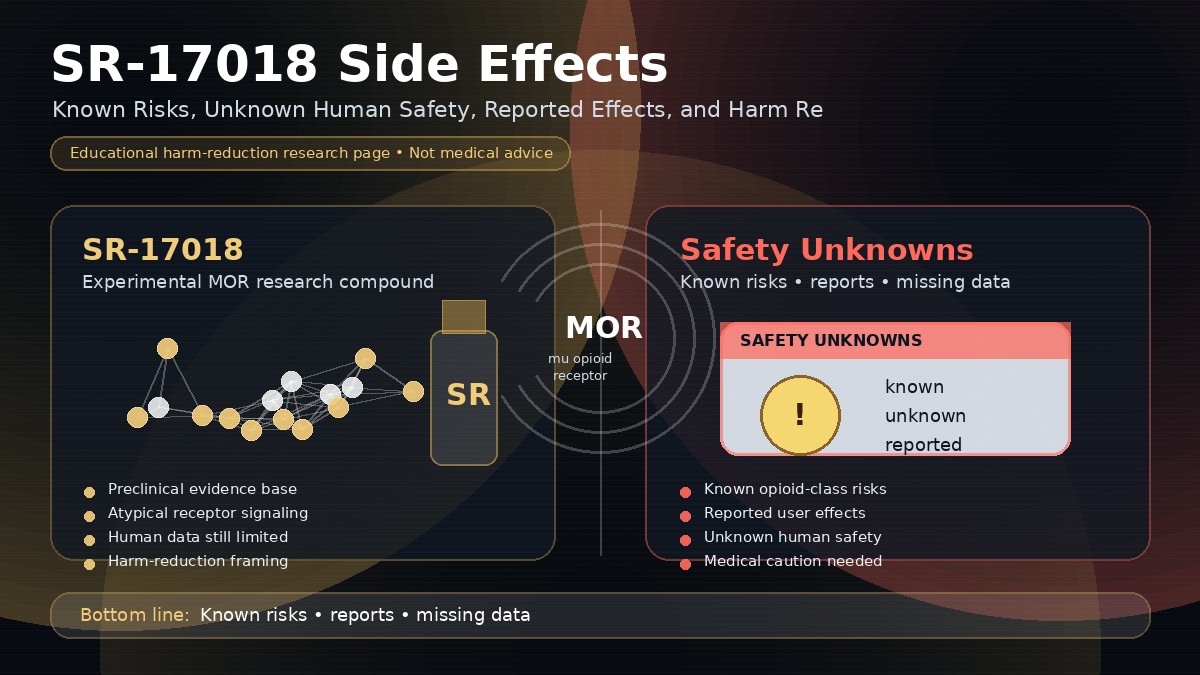
People searching for SR-17018 side effects are usually asking a practical question: what could go wrong?
The honest answer is that SR-17018 has preclinical safety signals, online human reports, and major unknowns. It does not have a complete human adverse-effect profile.
Known, Unknown, and Reported
Known from opioid pharmacology
Any compound acting at the mu opioid receptor deserves caution around respiratory effects, dependence, withdrawal, sedation, interactions, and overdose risk.
Unknown in humans
SR-17018 lacks the kind of controlled human safety dataset needed to define frequency, severity, dose relationship, and long-term risks.
Potential Opioid-Class Concerns
Because SR-17018 acts within the mu opioid receptor system, it should be discussed with opioid-class caution. Even if a compound behaves atypically in animal models, receptor activity can still create risks.
- respiratory depression
- sedation or impairment
- nausea or gastrointestinal effects
- tolerance or dependence
- withdrawal after repeated exposure
- drug interactions
- unexpected changes in opioid sensitivity
Reported Human Experiences
Online reports vary widely. Some people report minimal side effects, while others describe sleep changes, mood changes, agitation, lingering dysphoria, changes in opioid response, or other subjective effects. These reports are useful as signals but difficult to interpret as proof.
Many reports occur after exposure to fentanyl, kratom extracts, 7-OH products, buprenorphine, methadone, benzodiazepines, alcohol, or other substances. That makes clean attribution difficult.
The newest compound introduced is not automatically the cause of every later effect. Long prior opioid exposure can also explain major changes in mood, reward, sleep, and withdrawal.
Why Side Effects Are Hard to Measure
Controlled safety data require verified compound identity, known exposure, standardized monitoring, follow-up, and comparison groups. Informal human reports rarely contain all of those pieces.
That means SR-17018 safety discussion should avoid two extremes: vendor-style reassurance and panic-style certainty.
FAQ
Is SR-17018 safe?
There is not enough controlled human evidence to say SR-17018 is safe. It should be treated as an experimental compound with unknown human risk.
Can SR-17018 cause withdrawal?
Repeated mu opioid receptor exposure can create adaptation risk. Human withdrawal risk for SR-17018 is not well characterized.
Are online reports enough to define side effects?
No. They can reveal possible signals, but controlled human studies are needed to define risk clearly.
The Real Takeaway
The responsible side-effect message is simple: interesting preclinical profile, incomplete human safety data, and no room for casual certainty.
Sources and Further Reading
- Grim TW et al. A G protein signaling-biased agonist at the μ-opioid receptor reverses morphine tolerance while preventing morphine withdrawal. PMC full text.
- Fritzwanker S et al. SR-17018 stimulates atypical μ-opioid receptor phosphorylation and dephosphorylation. PMC full text.
- Pantouli F et al. Comparison of morphine, oxycodone and the biased MOR agonist SR-17018 in opioid tolerance and dependence models. PMC full text.
- Singleton S et al. Activation of μ receptors by SR-17018 through a distinctive mechanism. ScienceDirect.
- National Institute on Drug Abuse. Medications for Opioid Use Disorder. NIDA.