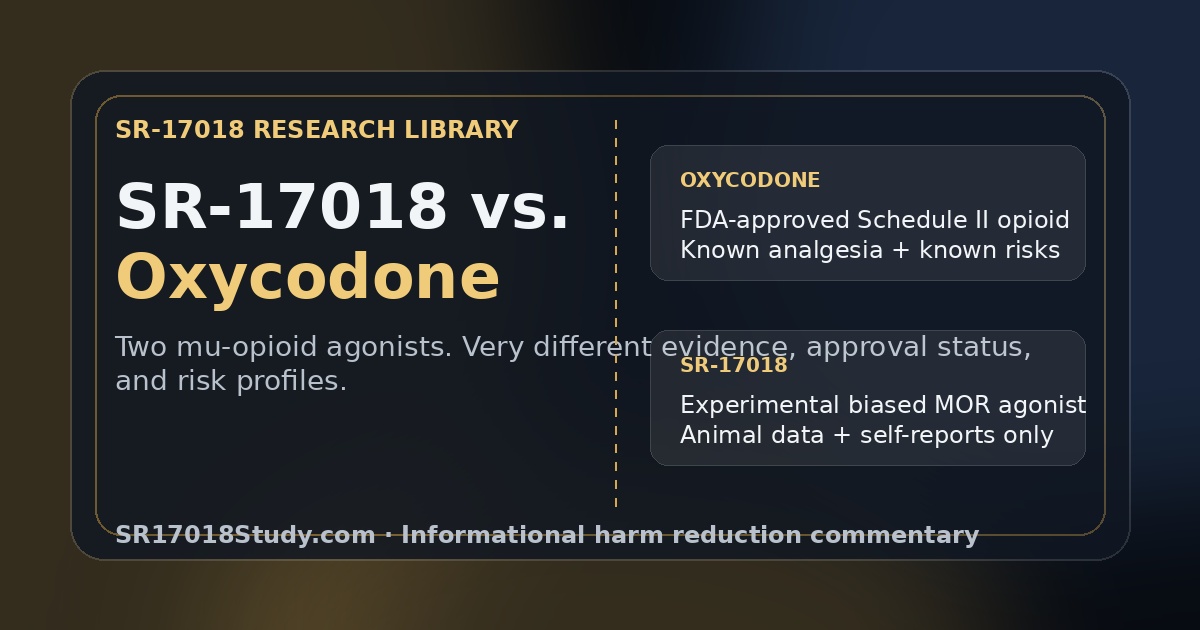
SR-17018 vs. Oxycodone
Two mu-opioid receptor agonists, one prescription drug that helped define the opioid epidemic, and one experimental compound now appearing in online harm-reduction and research-chemical communities.
The short answer
SR-17018 and oxycodone belong in the same broad conversation because both act through the mu-opioid receptor. That receptor is central to opioid analgesia, respiratory depression, euphoria, physical dependence, and withdrawal.
But they are not interchangeable. Oxycodone is a prescription Schedule II opioid analgesic with known human dosing, known risks, FDA labeling, decades of clinical use, and a long record of addiction and overdose harm. SR-17018 is an experimental biased mu-opioid receptor agonist with no approved medical use, no completed human clinical trials, no established dosing range, and a human evidence base built almost entirely from self-report.
Oxycodone is a known-risk medicine. SR-17018 is an under-studied opioid experiment.
That does not mean oxycodone is safe. It means its dangers are characterized. With SR-17018, the risk is more uncertain — and uncertainty is not the same thing as safety.
Why oxycodone history matters
Any honest comparison between SR-17018 and oxycodone has to include the history. Oxycodone is not just another opioid on a chart. It is one of the drugs that made the modern opioid crisis visible: first as a prescription medicine promoted for pain, then as a diverted street product, then as a driver of opioid dependence that helped create the market conditions for heroin and fentanyl to explode.
This history matters for SR-17018 because the same mistake repeats in every opioid cycle: a compound is framed through its potential upside while the downside is treated as theoretical until the human consequences become impossible to ignore. With oxycodone, that delay was catastrophic. With SR-17018, the evidence base is much thinner, so the burden of caution should be even higher.
Opioid prescribing rises sharply. OxyContin enters the market in 1996 and becomes one of the best-known products of the first wave.
Reports of OxyContin abuse, diversion, crushing, snorting, injecting, doctor shopping, and illegal distribution grow. Pill mills and cash pain clinics become a major supply route in some regions.
The second wave begins with rapid increases in heroin overdose deaths as prescription opioid supply tightens and heroin becomes cheaper and more available to an already opioid-dependent population.
The third wave begins as illicitly manufactured fentanyl and fentanyl analogs enter and then saturate parts of the illegal drug supply.
OxyContin and the first wave
Oxycodone existed before OxyContin, but OxyContin changed the scale of the story. Purdue introduced OxyContin to the U.S. market in 1996 as an extended-release oxycodone product. Sales grew rapidly, and by 2001 OxyContin had exceeded $1 billion in annual sales and had become the most frequently prescribed brand-name narcotic medication for moderate-to-severe pain in the United States, according to a GAO report.
The broader prescribing environment also changed. Pain was increasingly treated as undertreated, opioid therapy expanded, and aggressive promotion helped normalize long-term opioid prescribing beyond the older cancer/end-of-life context. That did not mean every prescription was reckless or every patient was harmed. It means the exposed population became enormous — and once a population that large is exposed to a dependence-forming drug class, a predictable percentage will develop tolerance, dependence, misuse, or opioid use disorder.
That is why the phrase “OxyContin started the opioid epidemic” is emotionally understandable but incomplete. The epidemic was not one molecule acting alone. It was a system: pharmaceutical promotion, changing pain-treatment norms, reimbursement incentives, physician education gaps, regulatory lag, diversion, and a drug supply that made potent opioids widely available.
The first wave was not simply a drug problem. It was a medical-market problem that created a much larger opioid-dependent population.
Pill mills, cash clinics, and the oxycodone pipeline
Once demand existed, pill mills turned medical legitimacy into distribution infrastructure. In the classic model, a clinic presented itself as pain treatment while operating more like a cash opioid storefront: fast visits, loose exams, questionable imaging, large quantities, and little real medical follow-up.
South Florida became one of the clearest examples. In 2011, the DEA described Florida as “ground zero” in the fight against pill mills during Operation Pill Nation, a takedown involving more than 40 pill mills, 340 undercover buys, 22 arrests, and charges tied to more than 660,000 dosage units of Schedule II oxycodone. The DEA also reported that a 30 mg oxycodone pill could sell on the street for $10 to $30 or more.
This is where oxycodone’s medical identity mattered. A pill produced by a pharmaceutical company and dispensed through a clinic or pharmacy carried a sense of legitimacy that heroin did not. People who would never have gone looking for a bag of heroin were handed opioid exposure through a prescription bottle. Then the diverted market put those same pills into the street economy.
The heroin transition
The crackdown did reduce parts of the pill supply. But the dependent population did not disappear when the pills became harder to get. Many people were already tolerant, sick without opioids, priced out, or cut off. When the prescription supply tightened, the market did what markets do: demand moved toward the cheaper substitute.
Heroin filled the gap because it acted on the same receptor system, was often cheaper than diverted pills, and became more available. The Congressional Budget Office reports that the retail price of a gram of pure heroin fell from $1,237 in 1992 to $552 in 2002 and $465 in 2012, measured in 2012 dollars. The National Academies review also notes that heroin was less expensive than black-market prescription opioids and that many heroin users had first used prescription opioids nonmedically.
That is the part people miss when they talk about crackdowns as if they end a crisis. Restricting a supply source can reduce one harm while pushing dependent people into a more dangerous market. The pill era built the population. The heroin era absorbed it.
How fentanyl entered the supply
Fentanyl did not appear because people suddenly forgot oxycodone mattered. It appeared because the market had already been transformed. There was a large opioid-dependent population, an established illicit supply chain, and a demand for opioids that could be transported, diluted, pressed, mixed, and sold at scale.
From a trafficking perspective, fentanyl had brutal advantages: high potency, low production cost, small transport volume, and no dependence on poppy cultivation. The CBO notes that fentanyl is relatively low-cost because it is produced in a lab and potent enough to move in small quantities that are difficult to detect. The DEA warns that illicit fentanyl is mixed into other drugs, sold as powders, and pressed into counterfeit pills made to look like legitimate prescription opioids.
That is why the fentanyl wave felt like all hell breaking loose. The margin for error collapsed. With heroin, potency varied. With fentanyl, tiny mixing errors could mean death. Counterfeit pills also blurred the boundary between the old prescription-opioid world and the new synthetic-opioid supply: a person might think they were buying oxycodone and instead receive a fentanyl-containing tablet.
The fentanyl crisis was not separate from the oxycodone era. It was the illegal market’s answer to the opioid-dependent population the pill era helped create.
Side-by-side comparison
| Category | Oxycodone | SR-17018 |
|---|---|---|
| Core mechanism | Mu-opioid receptor agonist analgesic. | Biased / atypical mu-opioid receptor agonist with unusual signaling and receptor-phosphorylation behavior. |
| Medical status | FDA-approved prescription opioid for severe pain when alternatives are inadequate. | No approved medical use. No completed human clinical trials. |
| Legal status | Schedule II controlled substance in the United States. | Not scheduled by name federally, but analogue-law and civil-liability risks remain unresolved. |
| Evidence base | Extensive human prescribing experience, FDA labeling, epidemiology, and overdose data. | Animal studies, receptor pharmacology, and self-reported human use. |
| Historical role | Central to the prescription-opioid first wave and pill-diversion era. | Not part of the historical epidemic; currently emerging in research-chemical and harm-reduction communities. |
| Respiratory depression | Known serious and life-threatening risk, especially with dose increases and CNS depressants. | Animal findings are mixed and route-dependent; it should still be treated as capable of suppressing breathing. |
| Dependence / withdrawal | Well-established risk with repeated use; abrupt discontinuation can cause withdrawal. | Animal studies show dependence and withdrawal; human withdrawal profile remains poorly characterized. |
| Naloxone reversal | Naloxone is standard emergency reversal for opioid overdose. | Laboratory studies report naloxone fully reverses receptor activation, but duration mismatch may require monitoring and repeat dosing. |
| Dose conversion | Has clinical dosing and opioid-conversion frameworks under medical supervision. | No reliable oxycodone-equivalent dose exists. Any conversion chart would be speculative and unsafe. |
What oxycodone is
Oxycodone is a semisynthetic opioid analgesic used in prescription products for pain severe enough to require an opioid when other treatment options are inadequate. It is a controlled prescription medicine because it can produce analgesia, euphoria, sedation, respiratory depression, constipation, tolerance, physical dependence, addiction, overdose, and death.
That last sentence is not moral language. It is pharmacology plus clinical history. Oxycodone is powerful because it activates opioid systems that change pain perception. The same receptor system that makes it useful also creates the risk.
Oxycodone is less dominant in today’s street supply than it was during the pill-mill era, but it remains important to understand because it is one of the clearest examples of how a legitimate opioid medicine can become a population-level disaster when exposure expands faster than caution, monitoring, treatment access, and honest risk communication.
What SR-17018 is
SR-17018 is an experimental mu-opioid receptor agonist developed in the context of biased agonism research. It was designed to favor G-protein signaling while producing comparatively less beta-arrestin2 recruitment, part of a broader attempt to separate opioid analgesia from some opioid harms.
That scientific rationale is real. But it has also been simplified online into claims that go far beyond the evidence: “safe opioid,” “non-addictive opioid,” “no respiratory depression,” or “better oxycodone.” Those are not established human facts. SR-17018 remains an unapproved research compound with preclinical promise, contested mechanistic interpretation, and incomplete human safety data.
Pain relief and evidence quality
Oxycodone has extensive human analgesic data, for better and worse. It works for pain, and because it works, it became widely prescribed. The tragedy is not that oxycodone was fake medicine. The tragedy is that real analgesia came packaged with dependence, tolerance, misuse risk, respiratory depression, and a marketing environment that minimized those consequences.
SR-17018 has shown antinociceptive effects in animal models, and several studies explored its unusual tolerance behavior. That is meaningful scientifically, but it is not the same as proof of safe or effective human pain treatment.
The strongest comparison is not “which one is better?” The strongest comparison is “which one has human evidence?” For oxycodone, the answer is extensive. For SR-17018, the answer is essentially none.
Respiratory depression and overdose risk
Oxycodone can cause life-threatening respiratory depression. The danger increases with higher doses, dose changes, other opioids, benzodiazepines, gabapentinoids, alcohol, sedatives, sleep medications, and other central-nervous-system depressants.
SR-17018 is often discussed online as if it solved respiratory depression. That is not a safe reading of the literature. Early animal reports suggested a wider therapeutic window than some classical opioids under specific experimental conditions, but later work complicated that story. Route of administration, intrinsic efficacy, receptor kinetics, and experimental model all matter.
The practical harm-reduction answer is simple: because SR-17018 is a mu-opioid agonist and because animal data do not eliminate respiratory risk, it should be treated as capable of causing opioid overdose — especially in polydrug use.
Dependence, withdrawal, and addiction
Oxycodone’s dependence liability is well known. Repeated use can produce tolerance and physical dependence, and abrupt discontinuation after sustained use can cause withdrawal. It can also produce addiction, misuse, compulsive use, and overdose.
SR-17018’s human dependence profile is not well characterized, but the absence of clinical characterization should not be misread as safety. Animal data report physical dependence and withdrawal after repeated exposure. Self-reported human use also shows a recurring behavioral pattern: people continuing to dose to stay ahead of withdrawal from prior opioids or from fear of stopping any opioid-like substance.
Reward and dependence are not identical. A compound can be less euphoric than oxycodone and still produce physical dependence. The “non-addictive opioid” framing is therefore misleading. The safer assumption is that sustained SR-17018 exposure can create opioid adaptation until proven otherwise in humans.
Medical and legal status
Oxycodone is medically approved but tightly controlled. Selling it outside legitimate prescribing channels is illegal, and giving someone else your medication can be dangerous and unlawful.
SR-17018 occupies a different legal risk category. It is not approved as a drug, not scheduled by name federally in the United States, and often sold under research-chemical language. But unscheduled status is not the same as legal safety. The Federal Analogue Act, intent-for-human-consumption evidence, product-liability claims, and wrongful-death exposure all remain live issues for sellers.
In that sense, oxycodone and SR-17018 sit on opposite sides of a strange divide: one is a regulated medicine with known risks; the other is an unapproved research compound with uncertain risks and uncertain legal exposure.
Why this page does not include a dose conversion
People often want to know how SR-17018 “converts” to oxycodone. That is the wrong question to answer publicly, because no validated human conversion exists.
Oxycodone dosing is based on human clinical data. SR-17018 has no approved formulation, no standardized purity across gray-market sources, no clinical dose-response curve, no established duration in humans, and no validated morphine milligram equivalent. A conversion table would create false precision and increase risk.
No one knows the safe oxycodone-equivalent dose of SR-17018. Any chart pretending otherwise is speculation dressed up as science.
Frequently Asked Questions
Is SR-17018 stronger than oxycodone?
There is no reliable human answer. Animal potency and receptor-assay comparisons do not translate cleanly into human dosing, subjective effect, or overdose risk. Because SR-17018 lacks clinical dosing data, strength comparisons can become dangerously misleading.
Did oxycodone start the opioid epidemic?
Oxycodone did not act alone, but OxyContin and other oxycodone products were central to the prescription-opioid first wave. The epidemic came from a wider system: aggressive promotion, expanding prescribing norms, diversion, pill mills, inadequate risk communication, and limited treatment access once dependence appeared.
Why did people switch from oxycodone pills to heroin?
Many opioid-dependent people moved toward heroin when prescription opioids became harder to obtain or more expensive. Heroin was cheaper, available, and pharmacologically substitutable because it acts on the same opioid receptor system.
How did fentanyl change the crisis?
Fentanyl changed the margin for error. It is extremely potent, relatively cheap to produce, easy to transport in small quantities, and now appears in powders and counterfeit pills. That made overdose risk far less predictable than the pill era.
Is SR-17018 safer than oxycodone?
That has not been established. SR-17018 has interesting preclinical findings, but no completed human clinical trials. Oxycodone is dangerous but characterized; SR-17018 is less characterized, which should increase caution rather than confidence.
Can naloxone reverse both?
Naloxone is used to reverse oxycodone overdose, and lab studies report that naloxone fully reverses SR-17018 receptor activation. With any suspected overdose, call emergency services; reversal can wear off before the opioid risk is over.
The takeaway
SR-17018 and oxycodone are linked by the mu-opioid receptor, but they are separated by evidence and history. Oxycodone is a regulated, dangerous, well-characterized opioid medication — and one of the clearest historical examples of how opioid exposure can scale into a public health disaster. SR-17018 is an unapproved, under-studied opioid research compound with promising but complicated animal data and almost no controlled human evidence.
The oxycodone story matters because it shows what happens when optimism outruns reality. First came pills. Then pill mills. Then crackdown. Then cheaper heroin moved into an already-dependent population. Then fentanyl entered a market built for opioids and made the overdose risk far less forgiving.
The honest comparison is not that SR-17018 is “better oxycodone” or a “safe opioid.” The honest comparison is that SR-17018 is trying to answer a question oxycodone made unavoidable: can pain relief, tolerance, withdrawal, respiratory depression, and addiction ever be separated cleanly enough to change opioid medicine?
Right now, that answer is not known. Until it is, SR-17018 should be treated with the caution owed to an opioid whose risks are still being discovered.
Related pages
Sources and Further Reading
- CDC, Understanding the Opioid Overdose Epidemic — the three-wave framework: prescription opioids in the 1990s, heroin beginning in 2010, and synthetic opioids / fentanyl beginning in 2013. CDC.
- GAO, OxyContin Abuse and Diversion and Efforts to Address the Problem — OxyContin market introduction in 1996, rapid sales growth, Schedule II status, abuse/diversion, and serious consequences including addiction, overdose, and death. GAO PDF.
- DEA, Operation Pill Nation — 2011 South Florida pill mill takedown involving more than 40 pill mills, over 660,000 dosage units of oxycodone, cash clinics, and street resale of 30 mg oxycodone pills. DEA.
- Congressional Budget Office, The Opioid Crisis and Recent Federal Policy Responses — prescription opioid oversupply, reduced availability of diverted pills, lower heroin prices, fentanyl’s low cost and transport advantages. CBO.
- National Academies / NCBI Bookshelf, Pain Management and the Opioid Epidemic — prescription opioid exposure, heroin transition, lower heroin cost, greater availability, and intertwined prescription/heroin epidemic dynamics. NCBI Bookshelf.
- DEA, Facts About Fentanyl — illicit fentanyl mixed into other drugs and pressed into counterfeit pills made to look like legitimate prescription opioids; lethal-dose variability and lack of quality control. DEA.
- DailyMed, Oxycodone Hydrochloride Tablets — FDA labeling for indication, Schedule II status, addiction/misuse warnings, life-threatening respiratory depression, CNS depressant interactions, and overdose guidance. DailyMed.
- DEA Oxycodone Fact Sheet — physiological effects including pain relief, sedation, respiratory depression, constipation, and abuse potential. DEA.
- Schmid et al., Cell (2017) — original description of G-protein-biased mu-opioid receptor agonists including SR-17018 and the early therapeutic-window claim. Cell.
- Grim et al. / Stahl et al., PNAS — SR-17018 and related biased agonists, noncompetitive activation, tolerance reversal, and naloxone-blockable receptor activation. PNAS.
- Fritzwanker, Schulz & Kliewer (2021) — atypical SR-17018 mu-opioid receptor phosphorylation and dephosphorylation; naloxone reversal of receptor activation. PMC.
- Kudla et al. (2021/2022) — comparison of addictive potential of novel and classical mu-opioid receptor agonists; SR-17018 showed rewarding properties and withdrawal syndrome in mice. PMC.
- Gillis et al. / Stahl et al. — low intrinsic efficacy and the complicated interpretation of biased agonism as a safety explanation. Science Signaling.
- SAMHSA National Helpline — 1-800-662-HELP (4357), free and confidential treatment referral and information service. SAMHSA.