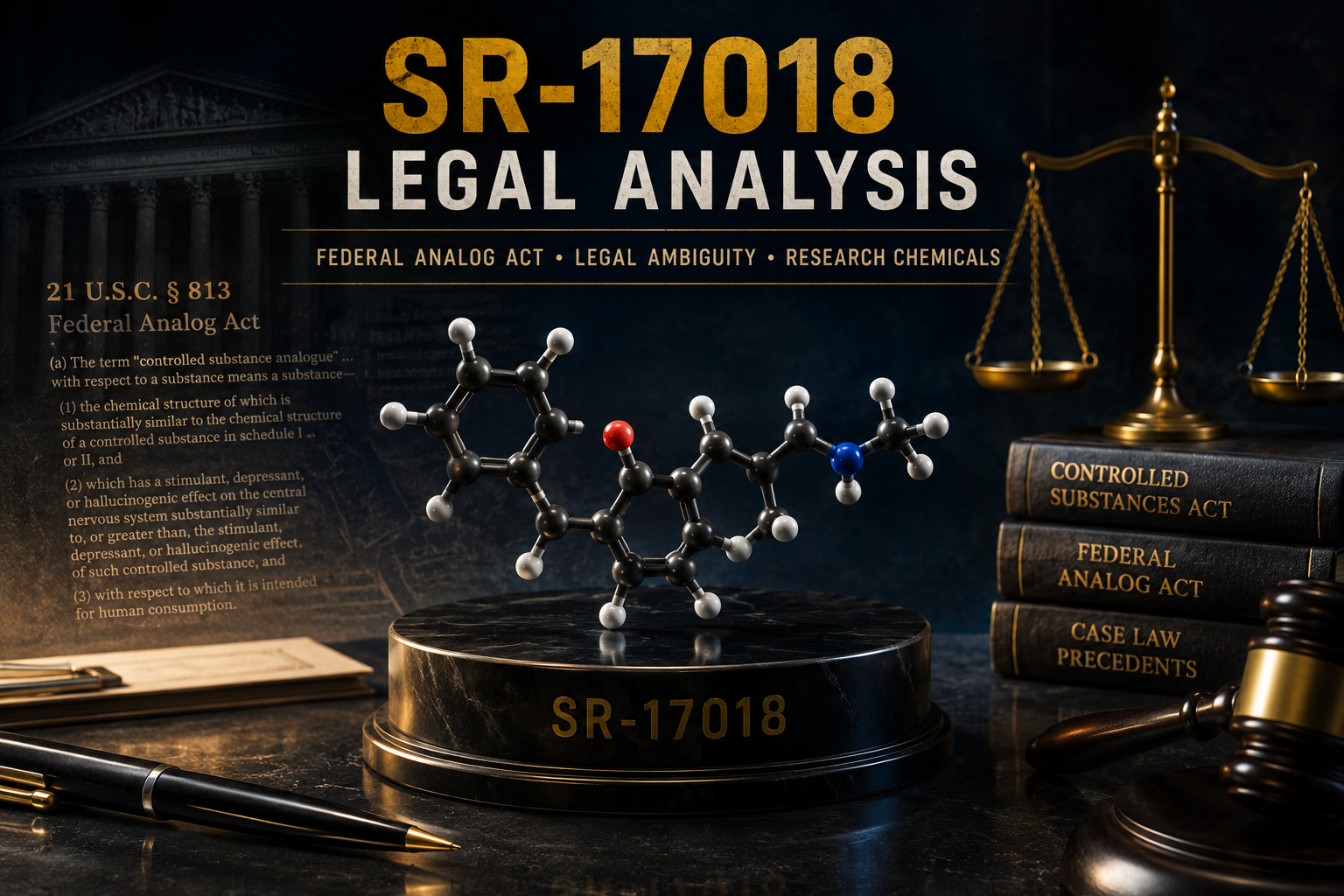
Is SR-17018 Legal?
Understanding the Federal Analogue Act, research chemical disclaimers, synthetic cannabinoid prosecutions, and why “unscheduled” does not mean legally safe.
Published by SR17018Study.com · Informational and harm reduction commentary · Not legal advice
SR-17018 is not specifically listed as a controlled substance under U.S. federal law. That is not the same as being legal — and the gap between those two things is the entire point of this page.
The fact that a compound isn't scheduled by name is, for many people, read as proof that it sits safely outside drug enforcement. The history of research chemical prosecution in the United States says otherwise. The legal framework that matters here — the Federal Analogue Act — was built specifically to reach substances that aren't on any schedule. It sits quietly in the background of the entire SR-17018 conversation, and most of what's written online about this compound ignores it completely.
What Is the Federal Analogue Act?
The Federal Analogue Act is codified at 21 U.S.C. § 813, working off the definition of "controlled substance analogue" in 21 U.S.C. § 802(32). In plain terms: a substance that isn't itself scheduled can be treated as a Schedule I controlled substance — but only to the extent it is intended for human consumption — if it qualifies as an analogue of a substance already in Schedule I or II.
To qualify, the statute requires the substance to be "substantially similar" in two respects that courts generally read together:
- Its chemical structure is substantially similar to a Schedule I or II controlled substance, and
- Its actual, intended, or represented effect on the nervous system is substantially similar to (or greater than) that of a Schedule I or II substance.
The statute, word for word
People argue about this section, so here is the actual text rather than a paraphrase. Under 21 U.S.C. § 802(32)(A), "controlled substance analogue" means a substance:
"(i) the chemical structure of which is substantially similar to the chemical structure of a controlled substance in schedule I or II; (ii) which has a stimulant, depressant, or hallucinogenic effect on the central nervous system that is substantially similar to or greater than the stimulant, depressant, or hallucinogenic effect on the central nervous system of a controlled substance in schedule I or II; or (iii) with respect to a particular person, which such person represents or intends to have a stimulant, depressant, or hallucinogenic effect on the central nervous system that is substantially similar to or greater than [that] of a controlled substance in schedule I or II."
Then 21 U.S.C. § 813 supplies the consequence: a controlled substance analogue, to the extent intended for human consumption, is treated as a controlled substance in Schedule I.
And § 802(32)(C) carves out what is not an analogue — most importantly, a substance with an approved new drug application, or one covered by an FDA investigational-use exemption. SR-17018 has neither. There is no approved NDA and no IND covering its use in people. That exclusion does not apply to it.
The "and" problem — the reason this section gets argued about
Look closely at how (i), (ii), and (iii) are joined. Clauses (ii) and (iii) are separated by "or." But clause (i) — the structure requirement — is connected to the rest with no "and" at all. Congress, by most accounts, dropped the conjunction by accident when it enacted the 1986 statute (see United States v. Forbes, 806 F. Supp. 232 (D. Colo. 1992), which walks through the legislative history).
That drafting glitch created the central fight in analogue law, and it is exactly where the "you're blowing smoke" objection lives. There are two readings:
- The two-prong reading (defense-favored, and the dominant one): a substance must satisfy clause (i) — substantially similar structure — and clause (ii) or (iii) — substantially similar effect or represented effect. Courts adopted this reading precisely to avoid absurd results. As Forbes pointed out, if effect alone were enough, caffeine or concentrated alcohol would qualify as analogues. Coffee has a stimulant effect; nobody thinks coffee is a Schedule I analogue. So structure has to be a required threshold, not optional.
- The one-prong reading (government-favored, mostly rejected): clause (ii) could stand on its own, so a substance with a substantially similar effect is an analogue regardless of structure. Courts have largely declined this, again to avoid the caffeine problem.
The practical upshot: the structure prong is the real battleground. A prosecutor essentially always has the effect prong handed to them for an opioid — and they have the represented/intended effect prong (clause iii) handed to them the moment anyone describes the compound as managing opioid withdrawal. The contested question in almost every analogue case is whether the chemical structure is "substantially similar" to a scheduled drug.
What "substantially similar structure" actually means to a jury
This is the most useful thing for cutting through the noise, because it's not anyone's opinion — it's the language courts read to juries. The Ninth Circuit's model jury instruction defines it this way: two chemicals are "substantially similar" when they "share a common core of identical chemical structural features" and the differences between them are not so significant as to make them substantially different.
That is a low bar, and it is decided by dueling expert chemists, not by a public registry. In United States v. Washam (8th Cir. 2002), the court upheld an analogue conviction for 1,4-butanediol as an analogue of GHB — the molecules aren't identical, but a jury credited the government's chemist that they shared the necessary core and produced the same effect. The defense's vagueness challenge lost. In United States v. Berger (8th Cir. 2009), the "but this other legal chemical also fits the definition, so it's arbitrary" argument lost too.
The lesson people resist hearing: "my molecule is not identical to a scheduled drug" is not a defense. Non-identity is assumed — that's the entire point of an analogue statute. It exists to catch the molecules that are deliberately not identical. As Forbes put it, the law is aimed at chemists who slightly alter a controlled substance's structure to stay off the schedules.
A mock prosecution: how the government would argue SR-17018 is an analogue
To show this isn't hand-waving, here is the case a federal prosecutor could assemble today, element by element. None of this requires SR-17018 to be scheduled. None of it requires scientific consensus. This is a walkthrough of an argument, not a prediction that it would be filed or that it would win — but every step is something the government has done before in a reported case.
Element 1 — Not otherwise excluded (§ 802(32)(C)). No approved NDA, no IND. The carve-outs don't apply. Trivial for the government.
Element 2 — Effect prong (§ 802(32)(A)(ii)). SR-17018 is a mu-opioid receptor agonist. Morphine and fentanyl are Schedule II; many opioids are Schedule I/II. A government pharmacologist testifies that SR-17018 produces opioid agonist effects — analgesia, and in animal data, respiratory depression and dependence — that are "substantially similar to or greater than" a scheduled opioid. Hard to contest; it's an opioid by mechanism.
Element 3 — Represented/intended effect prong (§ 802(32)(A)(iii)). This is the prong the therapeutic framing creates. Every forum post, vendor page, or study description saying SR-17018 helps with opioid withdrawal or tolerance is the government's evidence that someone "represents or intends" it to have an opioid-like CNS effect. The community's own language supplies this element.
Element 4 — Structure prong (§ 802(32)(A)(i)) — the real fight. The government's chemist maps SR-17018 onto a scheduled opioid and testifies they "share a common core of identical chemical structural features." The defense's chemist testifies the scaffold (a substituted piperidine benzimidazolone) is meaningfully different from classical opioid structures. This is where the case is actually won or lost, and — critically — it goes to a jury, which decides between two experts. Washam shows juries will side with the government even on contested chemistry.
Element 5 — Intended for human consumption (§ 813). Established by conduct, not the disclaimer: how it's sold, to whom, in what quantities, with what dosing discussion. (Detailed in the next section.) The withdrawal-management use case makes this nearly automatic.
Element 6 — Knowledge (McFadden, below). The government must show the defendant knew they had a controlled substance or knew the analogue-defining features. A sophisticated seller who explains the pharmacology proves this against themselves.
Add it up: of the six things the government needs, five are easy or self-supplied, and the one genuine fight — structure — is a coin-flip decided by competing experts in front of a jury, in a domain where juries have repeatedly sided with prosecutors. That is the smoke nobody wants to see. It is not a claim that SR-17018 is an analogue. It is a demonstration that the unscheduled status everyone leans on protects against exactly none of the six elements.
The government does not need scientific consensus before bringing charges. The legal exposure can become enormous long before any scientific dispute is resolved — and historically, that exposure has been used to extract guilty pleas precisely because defendants couldn't afford to bet the structure prong on a jury.
The Knowledge Requirement: McFadden v. United States
There is a second hurdle the government has to clear, and it cuts both ways.
In McFadden v. United States (2015), the Supreme Court held that to convict someone under the Analogue Act, prosecutors must prove the defendant knew they were dealing with a controlled substance. That knowledge can be shown two ways: either the defendant knew the specific substance's identity, or they knew it had the features — the substantially-similar structure and effects — that make it an analogue.
This is a genuine protection. It means accidental or ignorant possession is harder to prosecute than the statute's broad text might suggest.
But read it the other way, because it matters for anyone selling or seriously studying these compounds: the more clearly you understand a compound's opioid pharmacology, the easier the knowledge element becomes to prove. A vendor who markets SR-17018 by explaining how it hits the mu-opioid receptor has, in the same breath, helped establish exactly the mental state the government needs. Sophistication is not a defense here. It is closer to the opposite.
The "Not for Human Consumption" Problem
The most common move in the research chemical market is to sell a psychoactive compound as a laboratory material, stamp it "not for human consumption," and treat that phrase as a liability shield.
It is not a shield.
Under analogue law, intent for human consumption is inferred from the surrounding facts — not the label. Courts and prosecutors look at how a substance is marketed, packaged, priced, discussed, and distributed. Quantities sold, the customer base, website copy, promotional material, emails, forum activity, dosing discussions, the whole commercial picture. If those facts point at human use, the disclaimer is noise.
This isn't theoretical. Throughout the synthetic cannabinoid era, vendors used incense labels, novelty branding, and non-consumption language as standard practice. Federal prosecutors brought analogue cases anyway, and won them, when the surrounding conduct showed the products were meant to be used. The Cornell Legal Information Institute's overview of the Analogue Act makes the same point plainly: a "not for human consumption" disclaimer, on its own, does not defeat criminal liability.
I went through one of these prosecutions myself — a federal synthetic cannabinoid case. The government's theory wasn't built on the disclaimer. It was built on the conduct and the commercial reality around it. That experience is a large part of why I read research chemical legality the way I do.
The Synthetic Cannabinoid Era Changed Everything
The danger of analogue ambiguity became impossible to ignore during the synthetic cannabinoid wave of the late 2000s and early 2010s.
Compounds sold as Spice and K2 spread through smoke shops, gas stations, convenience stores, and online vendors across the country. Manufacturers altered molecular structures faster than regulators could schedule individual compounds — an escalating loop between underground chemistry and federal enforcement. The DEA leaned on emergency scheduling; Congress passed the Synthetic Drug Abuse Prevention Act in 2012; and prosecutors increasingly reached for the Analogue Act to cover everything in between.
A concrete example: in 2013, the U.S. Attorney's Office for the Northern District of Ohio indicted the owners of a chain of head shops, along with others, for conspiracy to distribute synthetic cannabinoids sold under names like Spice and K2. Several defendants ultimately pleaded guilty to conspiracy to possess with intent to distribute a controlled substance analogue, and prosecutors pursued prison terms and asset forfeiture. (These case records are public on the Department of Justice website.)
The lesson from that era is one line:
"Unscheduled" did not mean protected.
Prosecutors moved aggressively under analogue statutes, often with sentencing exposure severe enough to pressure plea agreements regardless of unresolved scientific debate about the compounds. Sentencing itself became contested — the U.S. Sentencing Commission later took up synthetic cannabinoid guideline issues, including the use of marijuana-equivalency ratios. Critics argued the sentencing math outran the science. The consequences for defendants were real either way.
Why SR-17018 Sits in a Different Conversation — and Why That Cuts Both Ways
There are real differences between SR-17018 and the compounds that defined the Spice and bath-salt years.
Many synthetic cannabinoids appeared with almost no legitimate pharmacological rationale — recreational intoxication and legal evasion were the point. Toxicity was poorly characterized, quality control was inconsistent, and the public health damage was severe.
SR-17018 has a different origin. It came out of legitimate pharmaceutical research at the Scripps Research Institute into mu-opioid receptor signaling and biased agonism (Schmid et al., Cell, 2017). Most current interest in it isn't about getting high — it's about opioid tolerance, dependence, withdrawal, receptor signaling, and harm reduction in the middle of an overdose crisis.
Here's the uncomfortable part, and it's the part the optimistic write-ups skip: to a prosecutor, "people are using this to manage opioid dependence" is not exculpatory — it is evidence of intent for human consumption, which is the exact element that activates the Analogue Act. The therapeutic framing that makes SR-17018 more sympathetic than Spice also makes the human-consumption inference easier, not harder. The legitimate-research origin is genuinely worth stating. It does not lower the enforcement risk, and anyone telling you it does is selling something.
This is the real policy tension: potentially useful compounds tend to surface in gray markets long before the formal medical system is willing or able to study them — while the government still holds statutory tools built to suppress emerging psychoactive drug classes fast.
The Commercialization Question
A newer wrinkle: the rapid commercialization of concentrated kratom-alkaloid products, especially 7-hydroxymitragynine extracts. Some companies in that fast-growing space have reportedly begun looking at SR-17018 and related compounds as adjacent product lines, apparently confident that its unscheduled status, some legal opinion, or "research use" positioning keeps it clear of analogue enforcement.
Those interpretations may or may not survive federal scrutiny. But the synthetic cannabinoid era settled one question:
The existence of a legal argument does not eliminate legal risk.
Prosecutors don't need internet consensus to bring charges. Once a compound becomes visible, controversial, or politically salient enough, the question stops being whether a vendor believes it's a lawful research chemical. It becomes whether prosecutors believe they can convince a court it's a controlled substance analogue intended for human consumption — and, under McFadden, that the seller knew what they had.
The Real Takeaway
None of this means SR-17018 is definitively illegal. It also doesn't mean prosecution is inevitable.
The reality is less comfortable than either extreme. SR-17018 sits in a legally uncertain space shaped by broad federal analogue statutes, shifting enforcement priorities, emerging commercialization, opioid politics, and a clear historical precedent for prosecuting unscheduled psychoactive compounds. That uncertainty is itself a form of risk — and it falls hardest on anyone selling or distributing, not merely reading about it.
At the same time, legal ambiguity shouldn't shut down honest scientific discussion or harm reduction. If anything the reverse is true: the more a compound spreads through unregulated markets, the more transparent research, observational data, and accurate public education matter. We've already watched what happens when psychoactive substances move faster than science, medicine, and public health can respond.
The goal is not panic. The goal is informed realism.
Frequently Asked Questions
Is SR-17018 a controlled substance in the United States?
Not by name. It is not specifically listed on the federal drug schedules. However, under the Federal Analogue Act (21 U.S.C. §§ 802(32), 813), it can be treated as a Schedule I substance when it is intended for human consumption and meets the "substantially similar" structure-and-effect test relative to a scheduled opioid.
Does labeling it "not for human consumption" make it legal to sell?
No. Courts and prosecutors infer intended use from the surrounding facts — marketing, pricing, quantities, customer base, and how the product is discussed — not from the disclaimer. A "not for human consumption" label, on its own, does not defeat criminal liability.
Is SR-17018 legal in the UK?
Almost certainly not to supply. The UK Psychoactive Substances Act 2016 is a blanket prohibition on producing or supplying any psychoactive substance not specifically exempted (medicines, food, controlled drugs already covered by the Misuse of Drugs Act). An opioid-active compound like SR-17018 would very likely fall within its scope.
Is SR-17018 legal in Germany or the EU?
Germany controls SR-17018 under the New Psychoactive Substances Act (Neue-psychoaktive-Stoffe-Gesetz, NpSG) as of 2025. Other EU member states vary; several operate their own blanket or analogue-style regimes. Status is jurisdiction-specific and changes over time.
Has SR-17018 been approved for medical use anywhere?
No. There are no completed human clinical trials and no approved medical use in any country. Everything known in humans is self-reported and uncontrolled.
Sources and Further Reading
- 21 U.S.C. § 802(32) — definition of "controlled substance analogue," including the "substantially similar" language.
- 21 U.S.C. § 813 — treatment of controlled substance analogues as Schedule I to the extent intended for human consumption.
- McFadden v. United States, 576 U.S. 186 (2015) — Supreme Court ruling on the knowledge requirement under the Analogue Act.
- United States v. Washam, 312 F.3d 926 (8th Cir. 2002) — upholding an analogue conviction (1,4-butanediol as a GHB analogue) and rejecting an as-applied vagueness challenge.
- United States v. Berger, 553 F.3d 1107 (8th Cir. 2009) — rejecting the "another legal substance also fits the definition" arbitrary-enforcement argument.
- United States v. Forbes, 806 F. Supp. 232 (D. Colo. 1992) — legislative history of the "and" drafting problem; the caffeine/coffee illustration of why structure must be a required prong.
- Ninth Circuit Model Criminal Jury Instructions (controlled substance / analogue) — the "common core of identical chemical structural features" formulation given to juries.
- Cornell Legal Information Institute — overview explaining that "not for human consumption" disclaimers alone do not avoid criminal liability.
- U.S. Attorney's Office, Northern District of Ohio (2013) — indictment of head shop owners and others for distribution of synthetic cannabinoids sold as Spice / K2; subsequent guilty pleas to conspiracy to distribute a controlled substance analogue (DOJ press releases).
- U.S. Sentencing Commission, Amendment 807 — synthetic cannabinoid sentencing and marijuana-equivalency practices.
- UK Psychoactive Substances Act 2016 (c. 2) — blanket prohibition framework for novel psychoactive substances.