SR-17018 vs Fentanyl
A harm-reduction comparison of receptor signaling, overdose risk, opioid withdrawal, tolerance, dependence, preclinical evidence, and why SR-17018 is not a proven fentanyl treatment.
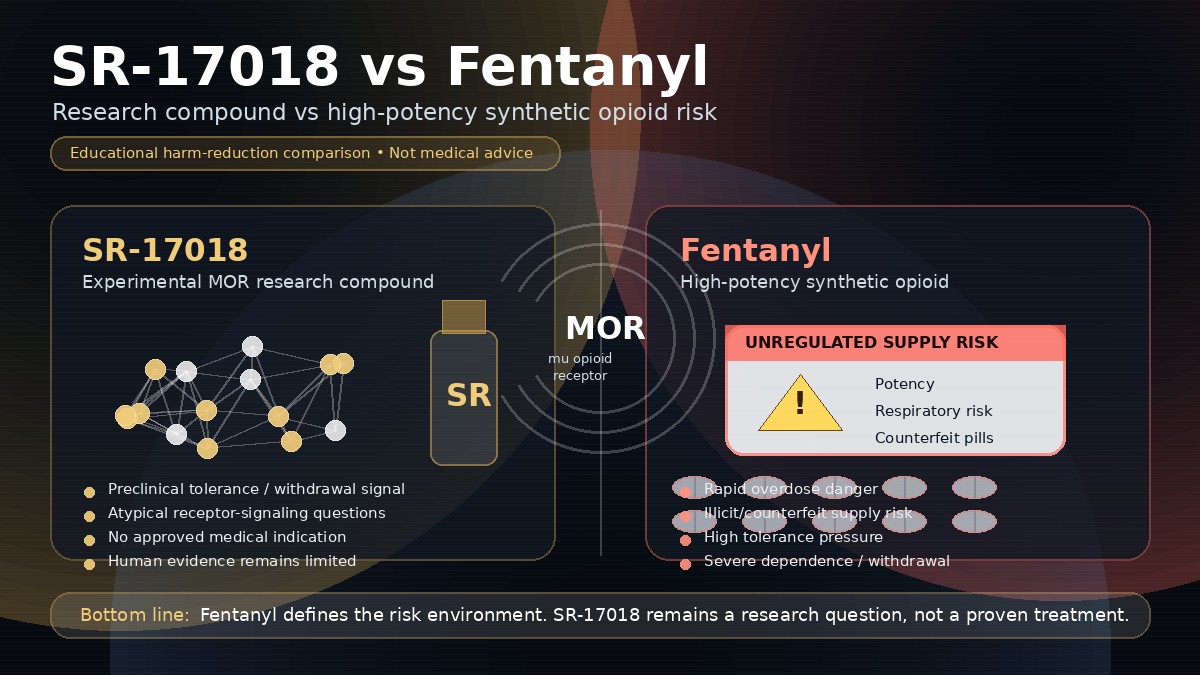
SR-17018 and fentanyl are sometimes mentioned in the same conversations because both involve the mu opioid receptor and both appear in discussions about opioid dependence, tolerance, withdrawal, and harm reduction.
That comparison is understandable in the fentanyl era.
It is also easy to misunderstand.
Fentanyl defines the modern opioid-risk environment. SR-17018 remains an experimental research compound, not a proven fentanyl treatment.
That distinction matters because fentanyl is not merely “another opioid.” It is a high-potency synthetic opioid that has reshaped overdose risk, drug supply contamination, tolerance patterns, and withdrawal experiences.
The Short Version
SR-17018
SR-17018 is an experimental mu opioid receptor research compound studied preclinically for atypical receptor signaling, tolerance, withdrawal, and dependence-related questions.
Fentanyl
Fentanyl is a high-potency synthetic opioid with legitimate medical uses, but illicitly manufactured fentanyl has become a major driver of overdose risk in the unregulated drug supply.
The responsible comparison is not “which one is better?” The responsible question is:
What makes fentanyl dependence so difficult, and what kind of evidence would be needed before any experimental compound could be discussed as part of a safer transition strategy?
What Is Fentanyl?
Fentanyl is a powerful synthetic opioid used medically for severe pain in specific clinical contexts. It acts primarily at the mu opioid receptor, producing analgesia but also carrying risks of respiratory depression, tolerance, dependence, and overdose.
The public-health crisis is driven largely by illicitly manufactured fentanyl and fentanyl analogs appearing in unregulated drug markets, including counterfeit pills and mixtures with other substances. This creates risk because people may not know what they are taking or how potent the product is.
The danger is not only fentanyl's pharmacology. The danger is fentanyl pharmacology inside an unpredictable, unregulated, counterfeit, and polysubstance drug supply.
What Is SR-17018?
SR-17018 is an experimental mu opioid receptor ligand that has attracted attention because preclinical studies suggest it may behave differently from many classical opioids in certain models of tolerance, withdrawal, respiratory effects, and receptor signaling.
The interest is not simply that SR-17018 activates the mu opioid receptor. The interest is that it appears to produce an atypical signaling profile in preclinical research, including findings that have raised questions about G-protein signaling, β-arrestin recruitment, receptor desensitization, tolerance, and withdrawal biology.
That scientific interest does not establish clinical safety or effectiveness in humans.
SR-17018 is relevant to fentanyl-era discussions because fentanyl dependence has exposed major limitations in current transition and withdrawal strategies. Relevance does not equal proof.
Why Fentanyl Changed the Withdrawal Conversation
Fentanyl has changed opioid withdrawal and stabilization discussions because many people report more difficult transitions, unpredictable timing, high tolerance, and challenging buprenorphine inductions compared with older heroin-dominated patterns.
Human fentanyl exposure is rarely clean or controlled. Real-world dependence may involve fentanyl, fentanyl analogs, xylazine, benzodiazepines, stimulants, alcohol, sleep deprivation, poor nutrition, chronic pain, psychiatric distress, and unstable housing.
That reality matters because a compound that looks interesting in an animal model may behave very differently in a person emerging from long-term exposure to a chaotic, high-potency opioid supply.
Fentanyl withdrawal is not just receptor pharmacology. It is receptor pharmacology plus real-world instability.
Receptor Signaling: High-Potency Agonism vs Atypical MOR Signaling
Fentanyl is generally discussed as a high-potency mu opioid receptor agonist. Its potency contributes to overdose risk, especially when it appears unexpectedly in counterfeit or contaminated products.
SR-17018 is usually discussed through a different lens: atypical mu opioid receptor signaling. The key scientific question is whether changing the signaling pattern at the same receptor could alter tolerance, dependence, withdrawal, or safety outcomes.
These are very different categories:
- Fentanyl: high-potency synthetic opioid associated with severe overdose risk in illicit markets.
- SR-17018: experimental compound studied for unusual MOR signaling and adaptation effects.
Both involve the mu opioid receptor, but they do not belong in the same evidence category.
Tolerance and Dependence
Fentanyl exposure can produce severe tolerance and dependence. In the illicit supply, repeated high-potency exposure can push tolerance upward quickly and make stabilization, tapering, or medication transitions more difficult.
SR-17018 has drawn attention because some preclinical studies suggest it may interact with tolerance and withdrawal biology differently than classical opioids. For example, animal research has reported that SR-17018 substitution restored morphine potency and prevented withdrawal signs in morphine-dependent models.
However, that is not the same as showing SR-17018 can safely treat fentanyl dependence in humans.
The scientifically responsible position is not “SR-17018 solves fentanyl withdrawal.” The responsible position is: “SR-17018 raises important questions about opioid receptor adaptation that deserve careful human research.”
Overdose Risk and Respiratory Depression
Fentanyl's overdose risk is closely tied to respiratory depression and high potency, especially when people are exposed without knowing the true contents or strength of a product.
Some preclinical SR-17018 discussions include respiratory-safety questions, but there is not enough human evidence to claim that SR-17018 is safe in uncontrolled real-world settings.
This distinction is essential. A compound may show an interesting profile in laboratory research while still carrying unknown risks when used without medical screening, toxicology confirmation, accurate measurement, or clinical monitoring.
Evidence Comparison
| Category | Fentanyl | SR-17018 |
|---|---|---|
| Basic category | High-potency synthetic opioid with medical and illicit-market contexts. | Experimental research compound studied for atypical MOR signaling. |
| Regulatory/clinical status | Approved medically in specific controlled settings; illicit fentanyl is a major public-health threat. | Not approved as a medication for withdrawal, OUD, pain, detox, or tapering. |
| Overdose risk | High, especially in unregulated or counterfeit drug supplies. | Human overdose and safety profile not established. |
| Withdrawal role | Chronic exposure can produce severe dependence and withdrawal. | Discussed because of preclinical tolerance/withdrawal findings, but not validated clinically. |
| Human evidence | Extensive medical, forensic, toxicological, and epidemiological data. | Very limited human evidence; mostly preclinical research and observational discussion. |
| Best current interpretation | Central driver of modern opioid harm in illicit markets. | Scientifically important research question requiring human data. |
Why People Ask About SR-17018 and Fentanyl
People ask about SR-17018 and fentanyl because the fentanyl era has created urgent, painful, and sometimes desperate treatment gaps. Some people struggle to transition onto buprenorphine, some fear precipitated withdrawal, and others have experienced repeated failed tapers or detox attempts.
That unmet need is real.
But unmet need does not convert an experimental compound into a proven medication.
Desperation can identify research priorities. It cannot replace clinical evidence.
Why SR-17018 Should Not Be Marketed as a “Fentanyl Detox Cure”
Any claim that SR-17018 is a proven fentanyl detox medication would be premature and irresponsible.
There are no established clinical protocols, no validated induction procedures, no approved dosing frameworks, no standardized taper schedules, and no large human safety datasets.
Fentanyl dependence is medically complex. The safest evidence-based options remain medical care, overdose prevention, naloxone access, and established medications for opioid use disorder such as buprenorphine and methadone when appropriate.
SR-17018 may deserve serious research precisely because the fentanyl crisis is so difficult. But it should be framed as a research question, not a commercial promise.
What Human Research Would Need to Show
Before SR-17018 could responsibly be compared to existing fentanyl-transition treatments, researchers would need controlled human evidence addressing:
- pharmacokinetics and duration
- dose-response relationships
- respiratory effects
- adverse effects and toxicity
- drug interactions
- withdrawal suppression
- reward and abuse liability
- tolerance and dependence
- transition outcomes after fentanyl exposure
- taper feasibility and post-acute withdrawal outcomes
Without those data, the correct stance is scientific curiosity rather than clinical certainty.
FAQ
Is SR-17018 the same as fentanyl?
No. Fentanyl is a high-potency synthetic opioid with approved medical uses and major illicit-market overdose risk. SR-17018 is an experimental research compound without approved medical use.
Can SR-17018 treat fentanyl withdrawal?
SR-17018 is not an approved treatment for fentanyl withdrawal. Preclinical studies make it scientifically relevant to withdrawal biology, but controlled human data are still needed.
Why are people comparing SR-17018 and fentanyl?
They are compared because both involve the mu opioid receptor and both appear in conversations about dependence, tolerance, withdrawal, and the search for safer transition strategies.
The Real Takeaway
Fentanyl and SR-17018 belong in the same broad opioid receptor conversation, but they do not occupy the same risk category or evidence category.
Fentanyl is a major driver of modern overdose risk, especially when illicitly manufactured fentanyl appears in unpredictable drug supplies. SR-17018 is a research compound that raises important questions about receptor signaling, tolerance, and withdrawal biology.
The most responsible position is neither hype nor dismissal.
Fentanyl defines the urgency. SR-17018 defines a research question.
That distinction is why observational data, transparent reporting, careful harm-reduction framing, and serious human research matter.
Sources and Further Reading
- National Institute on Drug Abuse. Fentanyl. NIDA.
- Centers for Disease Control and Prevention. About Overdose Prevention. CDC.
- SAMHSA. Overdose Prevention and Response Toolkit. SAMHSA PDF.
- Grim TW et al. A G protein signaling-biased agonist at the μ-opioid receptor reverses morphine tolerance while preventing morphine withdrawal. PMC full text.
- Fritzwanker S et al. SR-17018 stimulates atypical μ-opioid receptor phosphorylation and dephosphorylation. PMC full text.
- Pantouli F et al. Comparison of morphine, oxycodone and the biased MOR agonist SR-17018 in opioid tolerance and dependence models. PMC full text.
- National Institute on Drug Abuse. Medications for Opioid Use Disorder. NIDA.