SR-17018 and Respiratory Depression
Why respiratory depression is the central safety question for any mu opioid receptor compound, including experimental compounds with unusual signaling profiles.
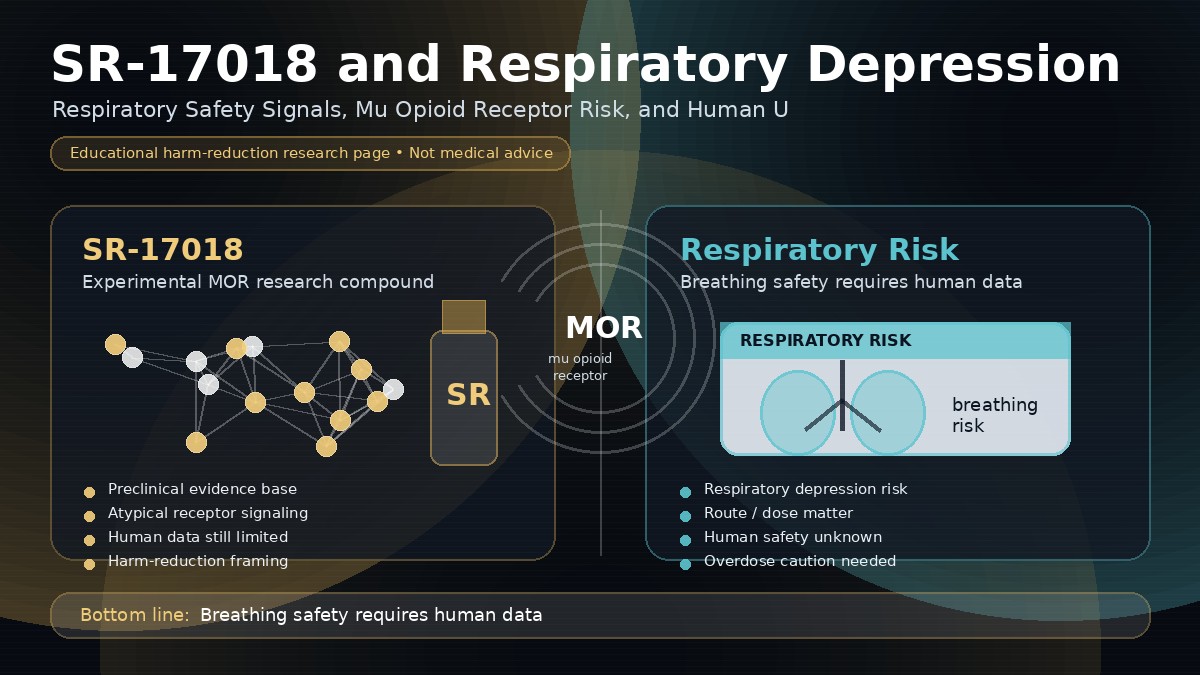
Respiratory depression is one of the most important safety questions for any compound acting at the mu opioid receptor.
SR-17018 has been discussed as potentially different from classical opioids in preclinical respiratory models, but human respiratory safety has not been established.
Why Respiratory Depression Matters
Opioid overdose kills largely through suppression of breathing. That is why any mu opioid receptor compound must be evaluated carefully, even if it has an unusual signaling profile.
Preclinical promise
Some SR-17018 work raised interest in a possibly different safety window than classical opioids.
Human uncertainty
Human respiratory effects, overdose risk, and interaction risks remain insufficiently characterized.
Preclinical Signals Are Not Human Proof
Animal studies can measure breathing rate, oxygen saturation, analgesia, and tolerance under controlled conditions. These models are important, but they are not the same as uncontrolled human use.
Later research also complicates simple claims. Route, bioavailability, dose, model, and species can all affect respiratory outcomes.
A safer-looking animal profile does not equal a safe human compound.
Drug Interactions
Respiratory risk can change dramatically when substances are combined. Alcohol, benzodiazepines, sedatives, gabapentinoids, other opioids, sleep medications, and unknown adulterants can all increase danger.
Without controlled human interaction studies, strong safety claims are not justified.
Overdose Reversal
This page does not provide emergency instructions, but suspected opioid overdose is always a medical emergency. Naloxone access and emergency medical response remain central harm-reduction priorities in opioid-risk environments.
FAQ
Does SR-17018 cause respiratory depression?
Preclinical findings are complex and do not establish human safety. Any mu opioid receptor compound deserves respiratory-risk caution.
Is SR-17018 safer than fentanyl or morphine?
There is not enough human evidence to make that claim. Comparative safety requires controlled human data.
Can SR-17018 be mixed with sedatives?
Combining opioid-system compounds with sedatives can increase risk. No validated human interaction framework exists for SR-17018.
The Real Takeaway
Respiratory safety is not a slogan. It is a data requirement.
Sources and Further Reading
- Grim TW et al. A G protein signaling-biased agonist at the μ-opioid receptor reverses morphine tolerance while preventing morphine withdrawal. PMC full text.
- Fritzwanker S et al. SR-17018 stimulates atypical μ-opioid receptor phosphorylation and dephosphorylation. PMC full text.
- Pantouli F et al. Comparison of morphine, oxycodone and the biased MOR agonist SR-17018 in opioid tolerance and dependence models. PMC full text.
- Singleton S et al. Activation of μ receptors by SR-17018 through a distinctive mechanism. ScienceDirect.
- National Institute on Drug Abuse. Medications for Opioid Use Disorder. NIDA.
- Hill R et al. Assessment of novel and classical opioids to induce respiratory depression. British Journal of Pharmacology.