SR-17018 Human Data
What is actually known in humans, what is still preclinical, and why observational reports should be treated as signals rather than proof.
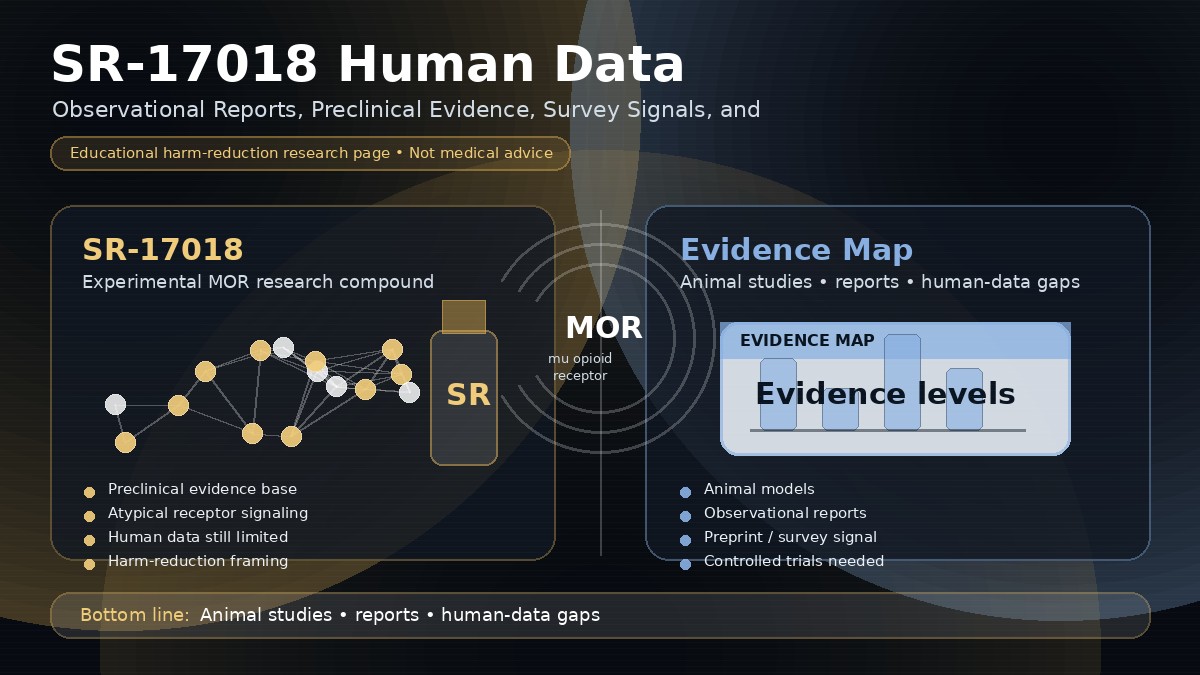
The most important question in the SR-17018 discussion is not whether the compound is interesting. It is. The real question is what level of human evidence actually exists.
SR-17018 has meaningful preclinical data, growing real-world reports, and early observational signals — but it does not yet have the kind of controlled human evidence needed to support clinical claims.
The Evidence Ladder
What exists
Animal studies, receptor-signaling studies, pharmacology papers, community reports, and early observational research.
What is still missing
Controlled human trials, validated dosing frameworks, safety datasets, interaction studies, and formal clinical protocols.
Preclinical Data
SR-17018 has been studied in animal models and receptor systems. Published work has examined mu opioid receptor signaling, morphine tolerance, withdrawal-related outcomes, phosphorylation dynamics, and comparisons with classical opioids.
These studies are valuable because they explain why SR-17018 deserves attention. They also define the limits of the evidence. Animal findings can generate hypotheses, but they do not automatically translate into human treatment.
Observational Human Reports
Human discussion around SR-17018 currently comes largely from real-world reports, community experiences, surveys, and early observational analysis. These reports can reveal patterns worth studying, especially when people describe withdrawal, tolerance, side effects, or transitions from other opioids.
However, observational reports are vulnerable to confounding. People may be using multiple substances, uncertain product identities, unverified batches, changing doses, and incomplete timelines. That makes causation difficult.
Observational data are useful for signal detection. They are not the same thing as controlled clinical proof.
The Attribution Problem
A major challenge in SR-17018 human discussion is attribution. If someone has used fentanyl, buprenorphine, methadone, kratom extracts, 7-OH products, benzodiazepines, stimulants, alcohol, or other substances, it may be impossible to confidently assign one outcome to SR-17018 alone.
This does not make user reports meaningless. It means they need careful interpretation.
What Human Research Would Need
- pharmacokinetic data
- dose-response data
- respiratory-safety data
- adverse-event tracking
- drug-interaction studies
- withdrawal and tolerance outcome measures
- validated patient selection criteria
- follow-up after discontinuation
FAQ
Is there human data on SR-17018?
There are human reports and early observational signals, but controlled clinical human data remain limited.
Does animal data prove SR-17018 works in humans?
No. Animal data can justify further research, but it cannot establish human safety or clinical effectiveness.
Why collect observational reports?
Observational reports can identify patterns, safety signals, and research questions that deserve formal study.
The Real Takeaway
SR-17018 is scientifically important because of the questions it raises, not because human clinical answers already exist.
Sources and Further Reading
- Grim TW et al. A G protein signaling-biased agonist at the μ-opioid receptor reverses morphine tolerance while preventing morphine withdrawal. PMC full text.
- Fritzwanker S et al. SR-17018 stimulates atypical μ-opioid receptor phosphorylation and dephosphorylation. PMC full text.
- Pantouli F et al. Comparison of morphine, oxycodone and the biased MOR agonist SR-17018 in opioid tolerance and dependence models. PMC full text.
- Singleton S et al. Activation of μ receptors by SR-17018 through a distinctive mechanism. ScienceDirect.
- National Institute on Drug Abuse. Medications for Opioid Use Disorder. NIDA.
- SR17018Study.com observational preprint record. Zenodo.