SR-17018 Mechanism of Action
A plain-English breakdown of why SR-17018 is mechanistically interesting, what biased agonism means, and why mechanism alone does not prove clinical usefulness.
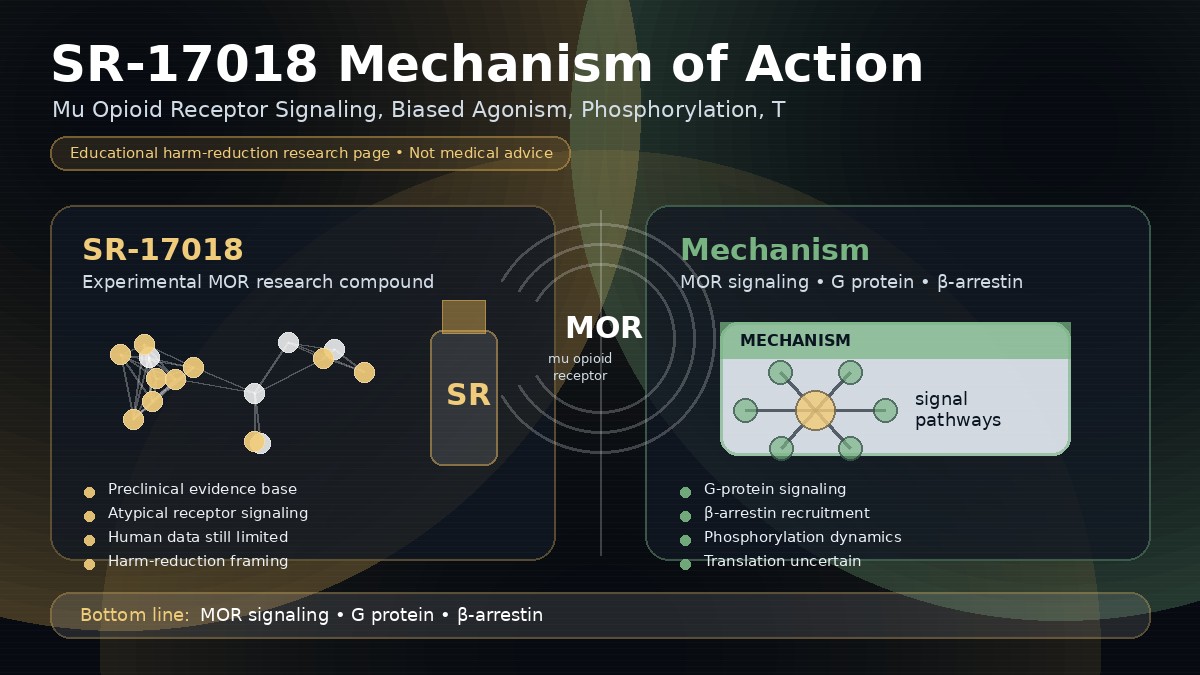
SR-17018 is discussed because it appears to challenge the simple idea that all mu opioid receptor agonists behave the same way.
The mechanism question is not just whether SR-17018 activates the mu opioid receptor. The question is how that receptor signals after activation.
Mu Opioid Receptor Basics
The mu opioid receptor is a G protein-coupled receptor involved in analgesia, reward, respiratory effects, tolerance, dependence, and withdrawal. Classical opioids such as morphine activate the receptor and can produce both desired and dangerous effects.
G-Protein Signaling and β-Arrestin
Biased agonism refers to the idea that different ligands can activate the same receptor while favoring different downstream signaling pathways. In opioid research, G-protein signaling and β-arrestin recruitment are often discussed because they relate to receptor activation, regulation, desensitization, and downstream effects.
G-protein signaling
Often discussed in relation to opioid receptor activation and analgesic signaling.
β-arrestin recruitment
Often discussed in relation to receptor regulation, internalization, desensitization, and some adverse-effect hypotheses.
Why SR-17018 Is Mechanistically Interesting
SR-17018 has been studied as an atypical mu opioid receptor ligand. Published work has examined its biased signaling, unusual phosphorylation and dephosphorylation profile, and distinctive receptor activation behavior.
This is why SR-17018 shows up in discussions of tolerance, withdrawal, receptor desensitization, and next-generation opioid pharmacology.
Mechanism explains why SR-17018 deserves study. It does not prove safety, effectiveness, or clinical usefulness in humans.
Phosphorylation and Receptor Regulation
Receptor phosphorylation can help scientists understand how a receptor is being regulated after activation. SR-17018 has been reported to produce a qualitative and temporal phosphorylation profile that differs from known biased, partial, or full mu opioid agonists.
That makes it scientifically unusual, but unusual does not automatically mean clinically superior.
Why Mechanism Alone Is Not Enough
A receptor-signaling profile cannot replace human safety studies, toxicology, pharmacokinetics, dose-response data, interaction studies, or clinical outcome trials.
The history of biased agonism in opioid pharmacology is complicated. The original idea remains important, but real-world translation has been more difficult than early simplified models suggested.
FAQ
What is SR-17018's mechanism of action?
SR-17018 acts at the mu opioid receptor and is studied for atypical signaling behavior, including G-protein-biased activity and unusual receptor phosphorylation dynamics.
Does biased agonism mean SR-17018 is safe?
No. Biased agonism is a mechanistic concept. Human safety and effectiveness require clinical data.
Why does mechanism matter?
Mechanism helps explain why SR-17018 may affect tolerance and withdrawal biology differently in preclinical models.
The Real Takeaway
SR-17018's mechanism is scientifically important, but the clinical question remains unanswered.
Sources and Further Reading
- Grim TW et al. A G protein signaling-biased agonist at the μ-opioid receptor reverses morphine tolerance while preventing morphine withdrawal. PMC full text.
- Fritzwanker S et al. SR-17018 stimulates atypical μ-opioid receptor phosphorylation and dephosphorylation. PMC full text.
- Pantouli F et al. Comparison of morphine, oxycodone and the biased MOR agonist SR-17018 in opioid tolerance and dependence models. PMC full text.
- Singleton S et al. Activation of μ receptors by SR-17018 through a distinctive mechanism. ScienceDirect.
- National Institute on Drug Abuse. Medications for Opioid Use Disorder. NIDA.