SR-17018 Half-Life and Duration
A careful explanation of half-life, duration, preclinical pharmacokinetics, and why animal data do not create a human-use protocol.
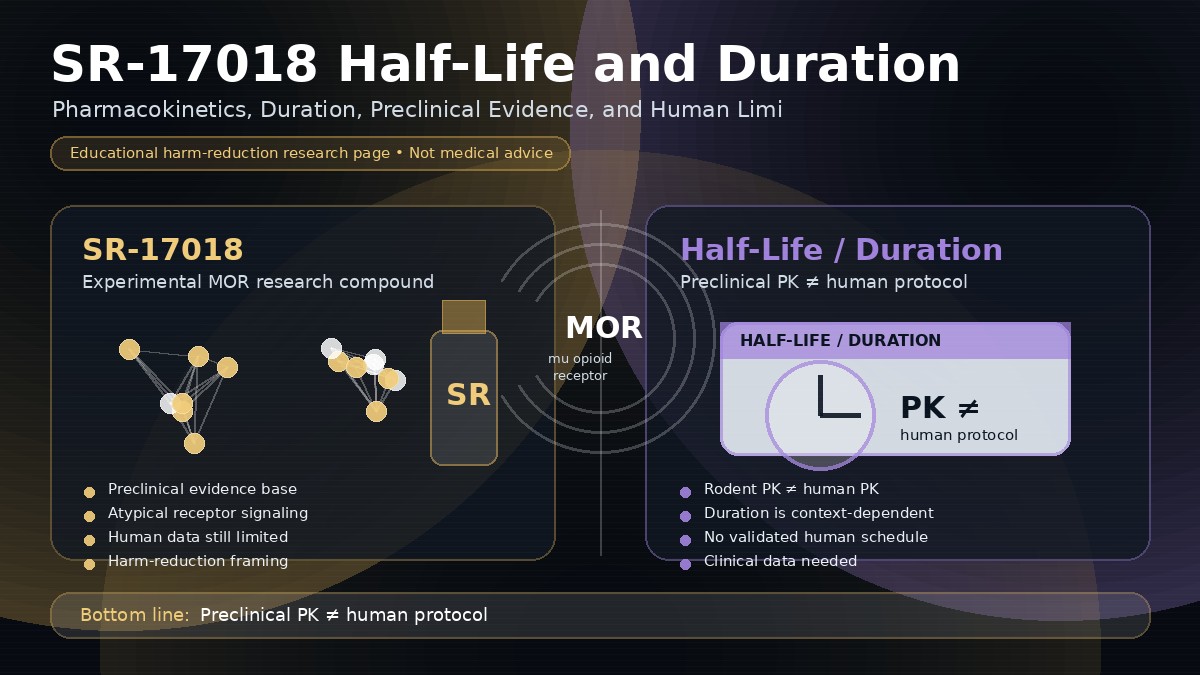
Search interest around SR-17018 half-life and duration usually comes from people trying to understand how long the compound lasts. That is a reasonable pharmacology question, but it can easily become unsafe if people turn incomplete data into human dosing assumptions.
SR-17018 duration data are mostly preclinical. Rodent pharmacokinetics do not create a validated human schedule.
Half-Life Is Not the Same as a Protocol
Half-life describes how long it takes for the amount of a compound in the body to decrease by half. Duration of subjective effect, receptor occupancy, withdrawal suppression, impairment, and safety risk can all differ from the simple half-life number.
Pharmacokinetics
How the body absorbs, distributes, metabolizes, and eliminates a compound.
Clinical duration
How long a person feels effects or experiences risk. This requires human data.
What Preclinical Data Can Tell Us
Preclinical work suggests SR-17018 has properties that made it useful in animal models of opioid tolerance, withdrawal, and receptor signaling. These findings help explain why the compound attracted attention.
However, animal pharmacokinetics may not translate directly to humans. Route of administration, bioavailability, metabolism, species differences, product purity, and individual biology can all change the practical duration.
Why Human Duration Is Hard to Infer
A person searching “how long does SR-17018 last?” may really be asking several different questions:
- how long does it remain detectable?
- how long does receptor activity persist?
- how long does withdrawal relief last?
- how long could impairment or interaction risk last?
- how long until another opioid response changes?
Those are not the same question, and none should be answered with casual internet certainty.
No Human Dosing Guidance
Because SR-17018 is not an approved medication, there is no validated dosing interval, taper schedule, or clinical monitoring framework. Any attempt to convert rodent half-life into a human protocol would be speculative.
FAQ
What is the half-life of SR-17018?
Published and secondary discussions describe preclinical pharmacokinetic findings, but human half-life and clinical duration are not established.
Can animal half-life predict human dosing?
No. Animal pharmacokinetics can guide research but cannot define a human dosing schedule.
Why does duration matter?
Duration matters for withdrawal, drug interactions, impairment, receptor adaptation, and safety monitoring.
The Real Takeaway
Half-life is a research parameter, not a human-use instruction.
Sources and Further Reading
- Grim TW et al. A G protein signaling-biased agonist at the μ-opioid receptor reverses morphine tolerance while preventing morphine withdrawal. PMC full text.
- Fritzwanker S et al. SR-17018 stimulates atypical μ-opioid receptor phosphorylation and dephosphorylation. PMC full text.
- Pantouli F et al. Comparison of morphine, oxycodone and the biased MOR agonist SR-17018 in opioid tolerance and dependence models. PMC full text.
- Singleton S et al. Activation of μ receptors by SR-17018 through a distinctive mechanism. ScienceDirect.
- National Institute on Drug Abuse. Medications for Opioid Use Disorder. NIDA.