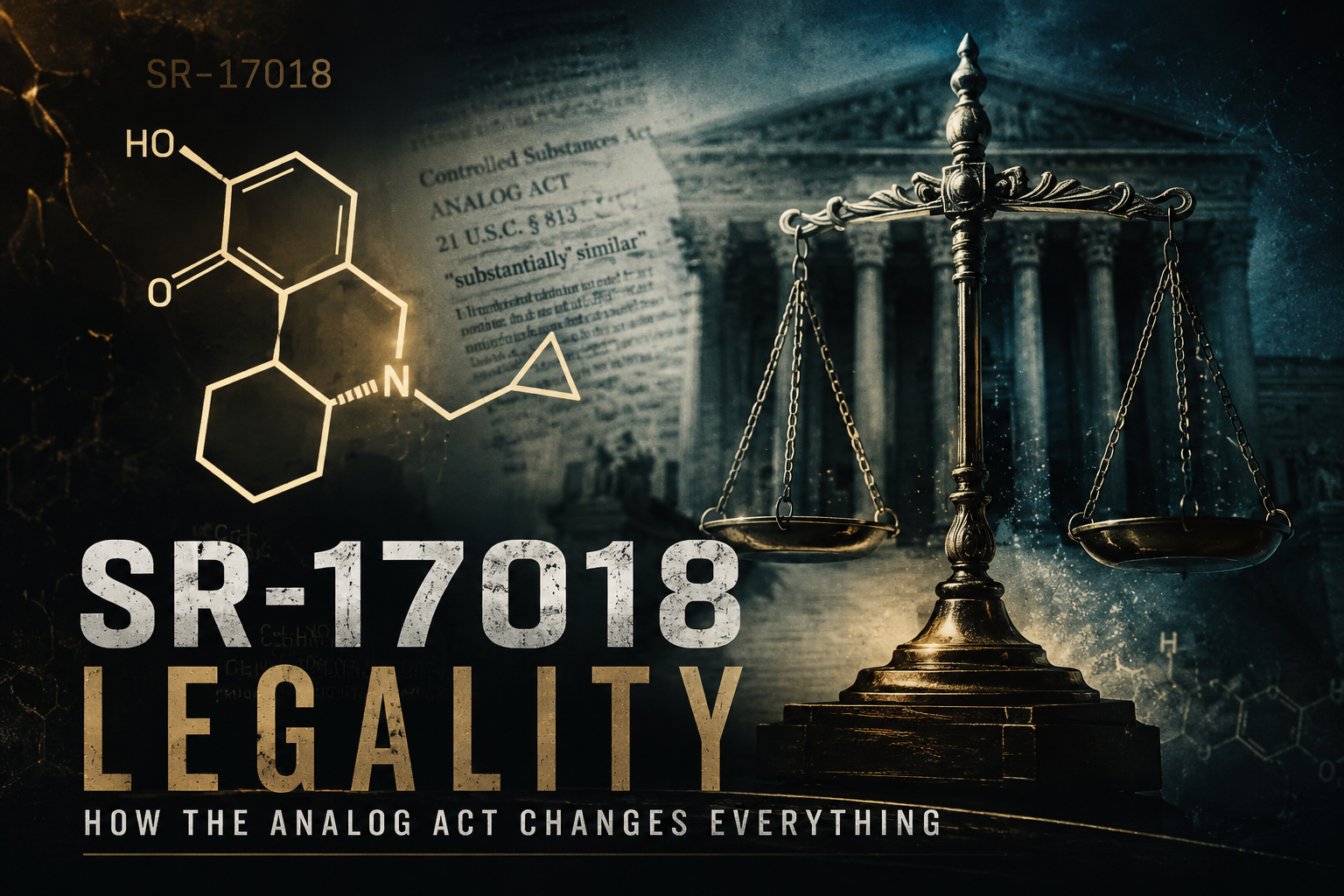
Is SR-17018 Legal?
Understanding the Federal Analog Act, research chemical disclaimers, synthetic cannabinoid prosecutions, and why “unscheduled” does not automatically mean legally safe.
Questions surrounding the legality of SR-17018 have increased as interest in novel opioid compounds continues spreading through online research chemical and harm reduction communities.
Much of this discussion centers around one simple observation:
SR-17018 is not currently scheduled federally by name in the United States.
For many people, that fact alone is interpreted as meaning the compound exists safely outside federal drug enforcement frameworks.
History suggests the reality is far more complicated.
The modern landscape of research chemical enforcement in the United States was dramatically shaped by the Federal Analog Act, which allows certain unscheduled substances to be treated as Schedule I controlled substances when they meet the legal definition of a controlled substance analogue and are intended for human consumption.
Today, that same framework sits quietly in the background of the SR-17018 conversation.
What Is the Federal Analog Act?
The Federal Analog Act is codified primarily through 21 U.S.C. § 813 and the definition of “controlled substance analogue” in 21 U.S.C. § 802(32). In simplified terms, the law allows substances not specifically listed as controlled substances to potentially be treated as Schedule I drugs if prosecutors argue they are substantially similar to already controlled compounds in chemical structure, pharmacological effect, or represented/intended effect when intended for human consumption.
The key phrase is:
“substantially similar”
That phrase changes everything.
Unlike a simple scheduling list, analog enforcement often becomes a matter of interpretation, expert testimony, prosecutorial strategy, and federal court litigation. The issue is not merely whether a molecule appears on a government list. The issue becomes whether prosecutors believe they can convince a court that a compound fits within the broader analog framework.
Importantly, the government does not necessarily need unanimous scientific consensus before initiating prosecution. The legal exposure can become enormous long before scientific disputes are fully resolved.
The “Not for Human Consumption” Problem
One of the most common moves in the research chemical market is to present a psychoactive compound as a laboratory material, label it “not for human consumption,” and claim that this language protects the seller from analog liability.
That assumption is dangerous.
Under federal analog law, intent for human consumption can be evaluated from the surrounding facts. Courts and prosecutors may look beyond the label and examine how the substance is marketed, packaged, priced, discussed, and distributed.
In practical terms, a disclaimer alone may not protect a vendor if the broader evidence suggests the product was being sold for human use. This may include the quantities being sold, the type of customer base, website language, promotional material, emails, forum activity, dosage discussions, or the overall commercial context.
The phrase “not for human consumption” is not a magic shield. If a company sells quantities and uses marketing patterns that appear inconsistent with legitimate laboratory testing, prosecutors may argue that the real intended use was human consumption.
This is not theoretical. During the synthetic cannabinoid era, vendors frequently used incense labels, novelty disclaimers, and non-consumption language. Federal prosecutors still brought analog cases when they believed the surrounding facts showed that the substances were actually intended for human use.
I saw this logic applied firsthand during my own synthetic cannabinoid case. The government did not simply look at a disclaimer. They looked at the surrounding conduct and commercial reality. That experience permanently changed how I view research chemical legality.
The Synthetic Cannabinoid Era Changed Everything
The dangers of analog ambiguity became highly visible during the synthetic cannabinoid era of the late 2000s and early 2010s.
Compounds sold under names like Spice and K2 rapidly spread across convenience stores, smoke shops, and online vendors throughout the United States. Manufacturers frequently modified molecular structures faster than regulators could specifically schedule individual compounds, creating an escalating cycle between underground chemistry and federal enforcement.
Eventually, federal prosecutors responded aggressively.
In 2013, the U.S. Attorney’s Office for the Northern District of Ohio announced indictments against owners of Ohio head shops and others for alleged distribution of synthetic cannabinoids sold under names such as Spice and K2. That case is one example of how federal analog enforcement moved into the commercial retail world once authorities viewed the substances as a public health and law enforcement priority.
One of the most important lessons from that era was simple:
“Unscheduled” did not mean protected.
Federal prosecutors were often willing to move forward aggressively under analog statutes, sometimes carrying extraordinary sentencing exposure capable of pressuring plea agreements regardless of ongoing scientific disagreement surrounding the compounds themselves.
Sentencing could also become severe. The U.S. Sentencing Commission later addressed synthetic cannabinoid guideline issues, including the use of marijuana equivalency ratios for synthetic cannabinoid cases. Critics argued that some sentencing practices moved faster than the underlying science, yet the legal consequences remained very real for defendants.
Why SR-17018 Exists in a Different Conversation
At the same time, there are important differences between SR-17018 and many of the compounds associated with the synthetic cannabinoid and bath salt epidemics.
Many synthetic cannabinoids emerged rapidly with little legitimate pharmacological discussion beyond recreational use and legal evasion. Toxicity profiles were often poorly understood. Quality control was inconsistent. Public health consequences became catastrophic.
SR-17018 exists in a different context.
The compound originated from legitimate pharmaceutical research investigating opioid receptor signaling and analgesia. Current interest surrounding SR-17018 is often connected not to recreational intoxication, but to discussions involving opioid tolerance, dependence, withdrawal, receptor signaling, stabilization, and harm reduction strategies surrounding the ongoing opioid epidemic.
That distinction matters.
While definitive human safety data remains limited, the broader conversation surrounding SR-17018 is often rooted in attempts to explore whether newer pharmacological approaches could potentially reduce some of the destructive outcomes associated with traditional opioid dependence.
In many ways, this creates a difficult policy tension. Potentially useful compounds may emerge in gray markets long before formal medical systems are prepared to study them responsibly. At the same time, the government still possesses legal frameworks originally designed to rapidly suppress emerging psychoactive drug classes viewed as public health threats.
The Commercialization Question
A new development further complicating the situation is the growing commercialization of highly concentrated kratom alkaloid products, particularly 7-hydroxymitragynine extracts.
Some companies operating in this rapidly expanding market have reportedly begun exploring SR-17018 and related compounds alongside their existing product lines. In some cases, these businesses appear confident that SR-17018 falls outside analog enforcement frameworks due to its unscheduled status, legal opinions, or research-use positioning.
Those interpretations may or may not ultimately survive federal scrutiny.
But one lesson from the synthetic cannabinoid era remains highly relevant:
The existence of legal arguments does not eliminate legal risk.
Federal prosecutors do not need internet consensus before bringing charges. Once a compound becomes visible enough, controversial enough, or politically important enough, the question may no longer be whether a vendor believes the substance qualifies as a lawful research chemical. The question becomes whether prosecutors believe they can successfully persuade a court that it is a controlled substance analogue intended for human consumption.
The Real Takeaway
None of this means SR-17018 is definitively illegal.
It also does not mean prosecution is inevitable.
The reality is more uncomfortable than either extreme. SR-17018 currently exists within a legally uncertain environment shaped by broad federal analog statutes, evolving enforcement priorities, emerging commercialization, opioid politics, and historical precedent surrounding psychoactive research chemicals.
That uncertainty itself carries risk.
At the same time, legal ambiguity should not automatically shut down scientific discussion or harm reduction efforts surrounding compounds that may hold legitimate research interest. In fact, one could argue the opposite: the more these compounds appear in underground markets, the more important transparent research, observational data, and public education become.
History has already shown what happens when psychoactive substances spread faster than science, medicine, and public health systems can respond.
The goal should not be panic. The goal should be informed realism.
Sources and Further Reading
- 21 U.S.C. § 802(32), definition of “controlled substance analogue,” including “substantially similar” language: U.S. Code, House of Representatives.
- 21 U.S.C. § 813, treatment of controlled substance analogues intended for human consumption: U.S. Code, House of Representatives.
- Cornell Wex overview explaining that “not for human consumption” disclaimers alone are not sufficient to avoid criminal liability: Cornell Legal Information Institute.
- U.S. Attorney’s Office, Northern District of Ohio, 2013 synthetic cannabinoid indictment involving Ohio head shops and products sold as Spice and K2: U.S. Department of Justice.
- U.S. Sentencing Commission Amendment 807, discussing synthetic cannabinoids and marijuana equivalency sentencing practices: U.S. Sentencing Commission.
- McFadden v. United States, Supreme Court discussion of the Analogue Act knowledge requirement: Justia U.S. Supreme Court Center.